
Artificial intelligence and machine learning in agri-food systems: A comprehensive review of technological frontiers, socio-ethical barriers, and future roadmaps
Mohsen Abbod 1*; Naser Safaie 2; Safaa N. Hussein 3
1, Department of Plant Protection, Faculty of Agricultural Engineering, Homs University, Homs, Syria
2, Department of Plant Pathology, Faculty of Agriculture, Tarbiat Modares University, Tehran, Iran
3, Department of Environmental Engineering, College of Engineering, Mustansiriyah University, Baghdad, Iraq
E-mail:
m.abbod@homs-univ.edu
Received: 18/04/2026
Acceptance: 04/08/2026
Available Online: 07/08/2026
Published: 01/01/2027

Manuscript link
http://dx.doi.org/10.30493/DAS.2026.010708
Abstract
Economic prosperity and human health heavily depend upon a stable food supply chain in agriculture. This essential network is fortified by modern farming techniques through boosted productivity and durability. Novel approaches are necessitated by the escalating worldwide need for nutrition. Consequently, agricultural practices and food security are positioned to be profoundly transformed by Artificial Intelligence (AI) and Machine Learning (ML). In this review, cutting-edge applications of AI in agriculture were investigated. A specific focus on precision crop management, optimized resource use, climate-resilient farming systems, and advanced livestock monitoring was undertaken. The article highlights how operational efficiency and decision-making are enhanced across all phases of any agricultural production system, such as planting, irrigation, pest control, harvesting, aquaculture, food safety, and post-harvest handling. This efficiency is attributed to the massive, heterogeneous datasets usually evaluated by AI frameworks to produce practical conclusions. Despite this promise, critical hurdles must be resolved to unlock the complete capabilities of AI in agriculture. Such barriers involve restricted access to high-quality data alongside computational limitations in developing regions. Serious ethical concerns regarding data privacy, algorithmic bias, and labor market disruptions also demand immediate attention. The deliberate mitigation of these complications is required to unlock the full potentials of AI for building a sustainable, fair, and food-secure tomorrow.
Keywords: Artificial intelligence, Precision farming, Deep learning, Food security
Introduction
A stable food supply is one of agriculture’s primary contributions to economic prosperity and human well-being [1]. Modern farming techniques aim to increase production, reduce costs, and build long-term resilience. Agriculture also supports human health by providing sustainable livelihoods and contributing to community well-being. Nevertheless, the sector faces substantial obstacles in meeting present and future food needs, including labor-intensive practices, biodiversity loss, climate change impacts, land degradation, and poverty coupled with rural population decline [2].
The urgency of increasing global crop yields has intensified due to these persistent challenges and a growing population. In this context, scientific innovations, agricultural data, and the technological revolution in artificial intelligence offer a path forward [3]. Consequently, modern technology, particularly artificial intelligence (AI) and machine learning (ML), is increasingly recognized as relevant to addressing agricultural problems, with the potential to improve practices and significantly boost production yields [4].
The adoption of novel technologies such as AI and ML represents a critical shift toward precise, intelligent, and sustainable agriculture [3][4]. This sector is undergoing an imminent transformation, as AI can rapidly evaluate large datasets from weather, soil, crop, and pest epidemiology reports. While traditional farming relies primarily on experience and historical knowledge, AI‑assisted analysis provides precise forecasts that support decision‑making in planting, irrigation, fertilization, and pest control [4][5].
This review examines the integration of AI and ML into modern precision agriculture across the following areas: (i) the evolution from traditional farming to precision agriculture; (ii) core AI and ML concepts relevant to agricultural applications; (iii) major applications of AI in smart agriculture; and (iv) challenges and opportunities in implementing AI solutions.
From traditional farming to precision agriculture
Agricultural technology evolution is a representation of a major shift from labor-intensive agricultural practices to high-tech AI-based agricultural technologies. Early methods involved manual hand tools, while the industrial revolution saw the emergence of mechanization, such as tractors and harvesters which significantly improved productivity levels. Later on, the introduction of chemical fertilizers and high-yielding crop varieties further boosted yields while reducing overall costs [4][5].
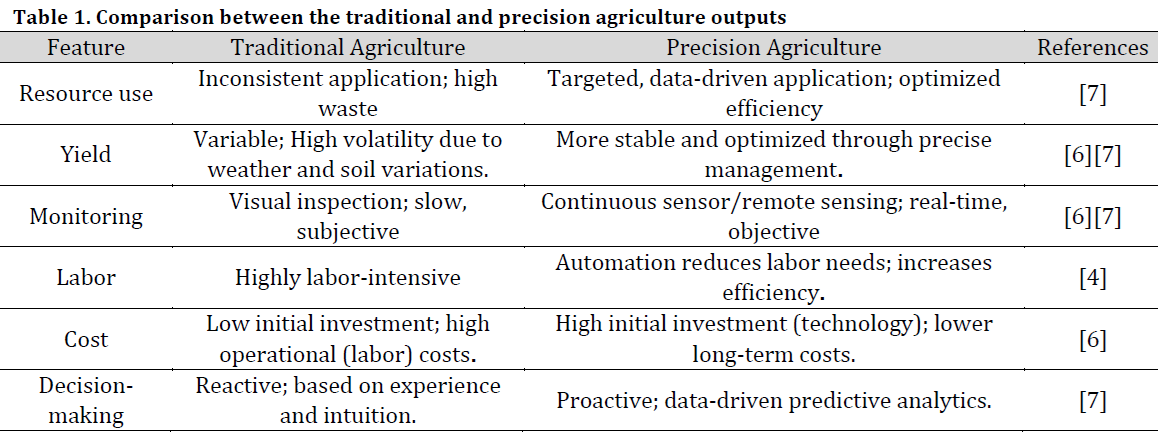
Building on this foundation, the contemporary agricultural society has adopted precision farming that harnesses the capacities of satellites and sensors in optimizing resource allocation. The application of artificial intelligence takes this concept to more advanced levels with predictive analytics for disease detection, automated irrigation based on real-time soil moisture data, and robotic ripeness detecting and harvesting[5][6]. Ultimately, this technological trajectory speaks to a sustained commitment, not only to enhancing productivity but also to minimizing environmental impact and ensuring global food security (Table 1).
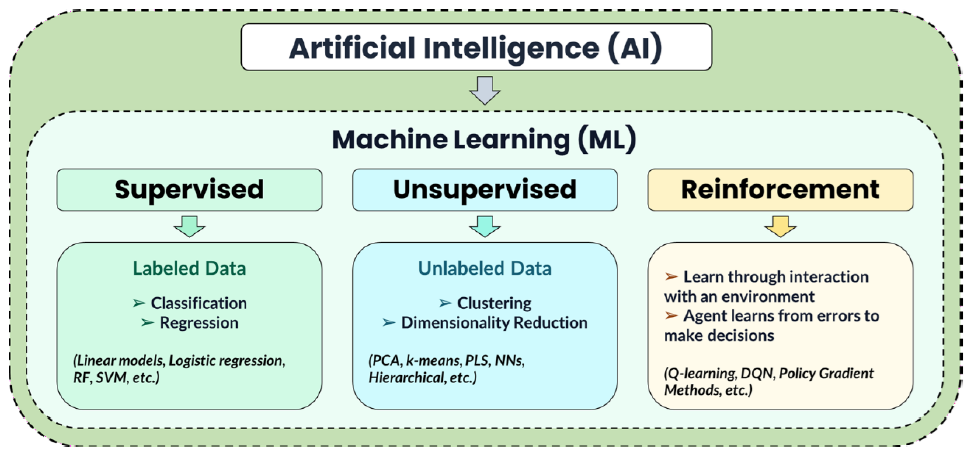
Artificial intelligence allows computer systems to handle learning and problem-solving tasks that require human intelligence [8]. AI is transforming diverse scientific fields, including drug discovery [9], materials science [10], climate science [11], education [12], economics [13], and agriculture [14]. Machine learning (ML), a core subset of AI, focuses on algorithms that learn from data rather than following explicit instructions [15]. ML encompasses three main paradigms (Fig. 1): (i) supervised learning, which uses labeled data for prediction [16][17]; (ii) unsupervised learning, which identifies hidden patterns in unlabeled data [16][18]; and (iii) reinforcement learning, where an agent learns optimal actions through trial-and-error interactions [19][20]. Deep learning (DL), an advanced ML subfield employing multi-layered neural networks, has driven recent breakthroughs by efficiently processing massive datasets [21][22]. These AI/ML tools are now transforming agricultural practices [23].
AI and ML applications in agriculture
Crop production and plant protection
Yield prediction and monitoring
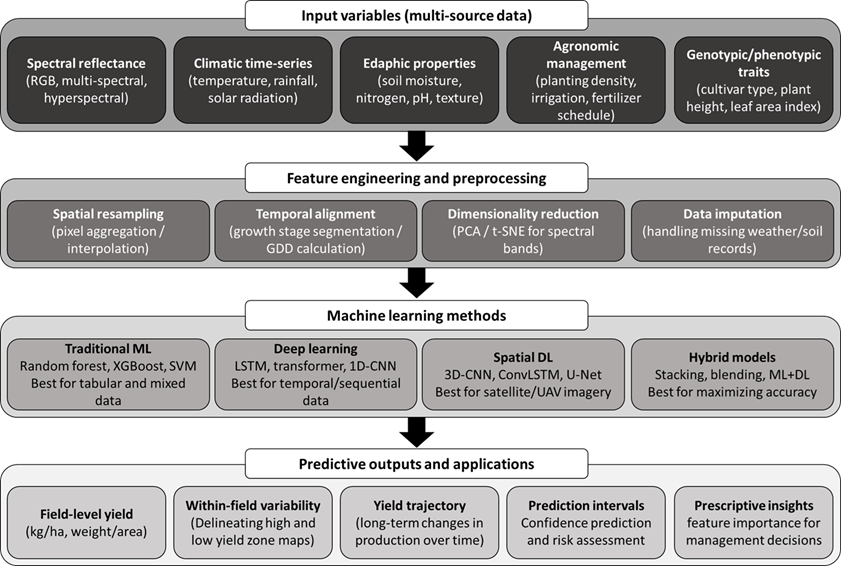
AI and ML tools process historical data, climate patterns, soil characteristics, and satellite imagery to predict crop yield dynamics (Table 2 and Fig. 2), thereby informing decisions about planting, irrigation, and harvesting [24][25]. However, prediction accuracy varies with the type of data used and the applied ML algorithm. For instance, Random Forest (RF) outperformed competing algorithms for sunflower and wheat yield prediction [25], whereas Recurrent Neural Networks (RNN) successfully predicted apple harvest dates, contributing to cost reductions [26].
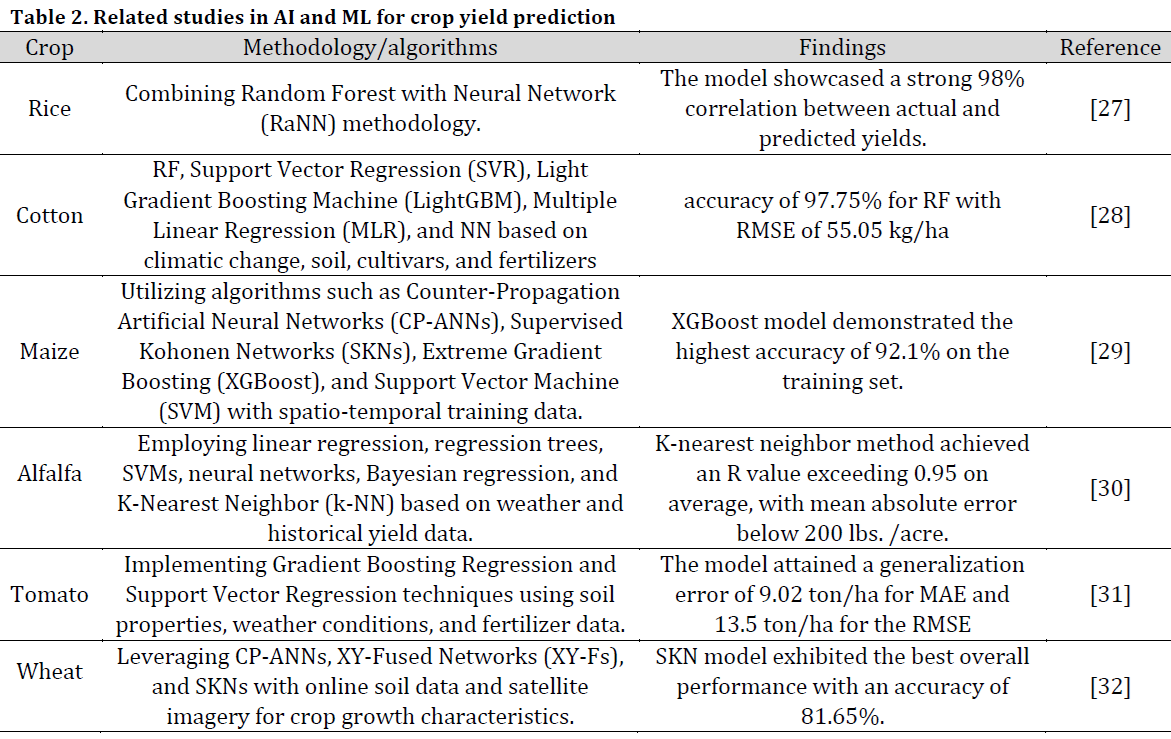
In this regard, studies reveal considerable variation in model accuracy across different crops (Table 2), ranging from 81.65% for wheat using SKN [32] to 97.75% for cotton using RF [28]. This variation suggests that model success depends not only on the algorithm’s inherent power, but also on the nature and homogeneity of input data and its relevance to crop-specific factors. For instance, the cotton model [28] benefited from integrated climatic and soil data, while the wheat model [32] relied on satellite imagery which may be less homogeneous. Consequently, generalizing a successful model from one crop to another requires retraining with local data, a key challenge in agricultural AI applications.
Postharvest quality
AI, ML, and DL technologies are increasingly integrated into postharvest quality assessments, including ripeness evaluation, defect detection, and storage condition monitoring [33][34]. In this regards, hyperspectral imaging is a valuable tool, as clustering algorithms leveraging this technology enabled non-destructive grading of Pleurotus eryngii [35], while SVM achieved 94.01% accuracy in predicting blueberry freshness using gas sensors during cold storage [36].
Plant breeding
AI can be utilized in plant breeding tasks to predict plant performance from complex data and highlight the best genetic combinations for optimized results [37][38]. AI-driven phenomics, which operates through digital sensors and hyperspectral cameras, generates detailed and high-level data on the various aspects of plant growth and their responses to stress factors, ultimately aiding in improving yield and resilience to biotic and abiotic stressors [39].
Plant disease, pest detection and weed control
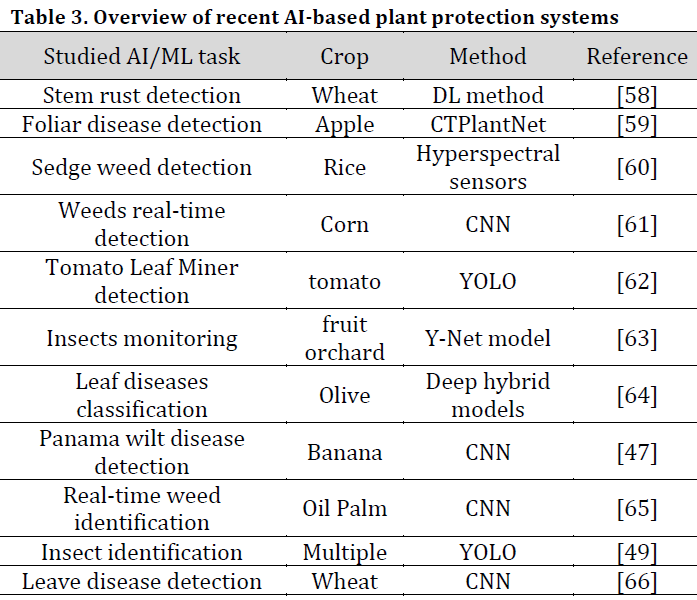
AI and ML technologies offer significant benefits for plant protection by improving the efficiency and accuracy of disease, pest, and weed detection (Table 3) [40][41]. AI algorithms excel at the early detection of disease symptoms, enabling prompt and effective intervention and reducing fungicide dependency [42][43]. Various ML algorithms, including SVM [44], RF [45], and Neural Networks [46], are widely used for disease identification. For example, a deep learning model achieved 91.56% accuracy in detecting Panama wilt disease in banana leaves [47], while SVM outperformed Convolutional Neural Network (CNN) in potato blight detection when working with smaller datasets [44].
From an entomological point of view, traditional insect identification methods are labor-intensive and require specialized taxonomic expertise [48]. AI addresses this limitation through tools like YOLO (You Only Look Once) algorithms, which successfully detect multiple small insects in large images [49]. Hybrid approaches combining SVM, RF, and ANN with deep learning features (ResNet152, InceptionV3, DenseNet201) have also proven effective for classifying chili pests and diseases [50].
Moreover, AI enables site-specific identification and mapping of weeds, reducing herbicide use and improving sustainability [51][52]. Weeds compete with crops for resources, causing significant economic losses [51]. An integrated approach combining YOLO v4-based weed detection with cover crop strategies demonstrated potential for improving control while reducing herbicide reliance [53].
Pesticides developing
AI accelerates pesticide development by analyzing datasets, predicting efficacy, and identifying synergistic mixtures [54][55]. For example, researchers used SVR and ANN to model synergistic interactions in binary fungicide mixtures, aiding resistance management [54]. Similar ML approaches (SVM, GPR) predicted fungicide interactions against Macrophomina phaseolina [56] and improved toxicity prediction for honeybees [57].
The promising results from computational models predicting synergistic interactions [54-56] provide a valuable foundation for pesticide development. However, the ultimate performance of these optimized mixtures under real-world field conditions, where soil variability, climatic factors, and microbial communities interact, remains to be fully explored. Therefore, integrating these computational predictions with field validation studies represents a critical direction for future research.
Phyto-microbiome research
The integration of AI and ML with microbiome research provides significant capabilities to process complex microbial datasets and identify beneficial or detrimental plant-microbe interactions [67][68]. One such way in which ML is increasingly being used is in predicting plant traits like stress response, genotype, and productivity from microbiome data [69][70]. The prediction of the overall phenotype based on the whole microbial consortia, including its interactions with the plant’s genotype and the environment, rather than on individual microbial taxa, is emerging as a focus of research with several studies demonstrating this potential [69]. Machine learning (random forests and bagging models) was used to analyze citrus microbiome data, achieving accurate prediction of HLB disease status based on bacterial profiles in the rhizosphere and phyllosphere [71]. Similarly, Random Forest classifiers trained on soil microbiome data successfully predicted drought stress in grasses with 92.3% accuracy at the genus level [72].
Soil and water management
Soil and water management are key elements for sustainable agriculture, with both contributing to future productivity and sustainability of the land resources [73]. The field of soil and water management has seen remarkable advancements with the development of AI technologies by analyzing the bulk datasets regarding soil type, moisture, nutrient content, and pH to produce predictions [73].
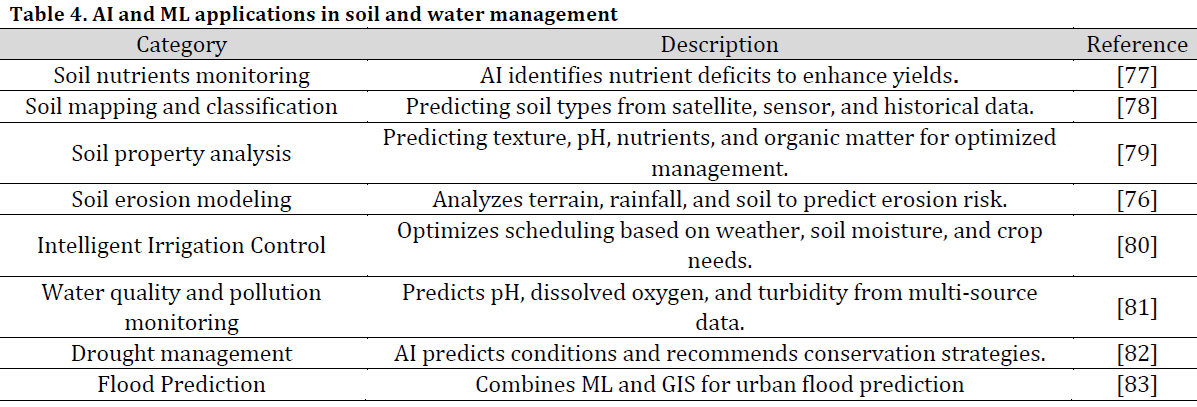
Machine learning algorithms have been successfully applied to diverse soil-related challenges. Researchers evaluated several algorithms for soil organic carbon prediction and mapping, demonstrating that Deep Neural Networks (DNN) outperformed other models in accuracy [74]. In irrigation management, a Fuzzy Neural Network integrated with wireless sensor networks successfully determined crop water requirements, enabling precise irrigation and fertilizer application with high accuracy [75]. For soil erosion assessment, erosion pins were combined with Artificial Neural Networks to identify splash erosion as the primary driver of soil loss on lower slopes, highlighting AI’s value in understanding spatial erosion patterns [76]. Table 4 summarizes key AI applications in soil and water management.
Despite these promising applications, most of the currently available models have been trained with localized data. Thus, their ability for generalization to other agroecological zones needs to be investigated. For instance, a DNN model, which successfully mapped soil organic carbon in Northern Iran [74], may not perform equally in the other mineralogical soils and climatic conditions unless trained using the local soil data. This would be similar to what is reported for the prediction of crop yield, where the sophistication of an algorithm is far more or less important than the quality of input data. Future studies would thus need to focus on training comprehensive models with representative multi-regional data, so that they could be transferred to varying soil and environmental conditions.
Climate impact assessment
AI and ML are increasingly recognized as vital tools for addressing climate change risks in agriculture. By analyzing large datasets, these technologies enhance weather and climate modeling, enabling the quantification of risks from extreme events such as floods, droughts, heatwaves, and wildfires [11][84].
In the practical application, the scope of AI in farming can be further detailed. Weather-based prediction of yields uses an algorithm to monitor moisture, temperature, and soil moisture content, thereby refining the forecasting of crop yield under different climate conditions [84]. Early warning systems use imagery from satellites, data from weather stations, and historical records to simulate potential future climate conditions and thus assist farmers in planning preemptively [85][86]. On a macro-level, AI-assisted satellite imagery analysis enables the detection of deforestation, indicating areas that may need protection against agricultural expansion, helping farmers to keep pace with climate change-related land usage [87]. Also, it can aid in monitoring changes in soil, hence provides information for land management practices to retain carbon sequestration capacity [85][88].
Although machine learning models can predict crop yields accurately based on historical climate data, many models fail when trying to predict crop yields under novel climate scenarios that have never been seen before. For example, Bayesian ensembles showed that even if a black-box model had a decent prediction capability, it may be doing so for the wrong relationships, rather than capturing the true link between climate and crop performance [84]. This is a major problem for the accuracy of predicting crop yields under a future climate, since even if a model is providing accurate predictions under current conditions, this does not necessarily mean it will perform well under novel conditions. Consequently, researchers emphasize the need for interpretable machine learning models that help understand underlying mechanisms, rather than focusing solely on getting a high prediction accuracy.
Livestock monitoring and management
AI solutions are having an effect on several areas of livestock management, from nutrition optimization to healthcare monitoring [89]. Precision feeding involves using AI and ML to build individualized animal profiles based on animal age, weight, production status, and health condition. This approach allows optimal nutrition delivery for optimum growth and reduced expenses, since feed is one of the primary expenditures in any livestock operation [89]. Animal healthcare has improved through wearable sensors monitoring temperature, heart rate, activity, and respiration rates to anticipate problems [90] and using face recognition software to detect illness from the animal’s facial cues and behavior [90][91].
AI application in controlling the environment with infrared thermography helps optimize the atmosphere for animal comfort and production sustainability [92]. The process of sex identification, which was labor-intensive and inaccurate before, has been refined by the application of AI utilizing video and sensor inputs, which allows more accurate detection of sex at earlier stages [93][94]. Examples within the dairy industry which apply the mentioned technologies include the application of AI into robotic milking stations to predict yield, optimize resource utilization, and identify potential health problems at an early stage, thereby greatly enhancing the competitiveness of the industry [95][96].
Impact of AI on aquaculture
The rapid growth of global seafood demand has positioned AI and ML as essential tools for balancing productivity, animal welfare, and environmental sustainability in aquaculture [97-100]. Water quality management, critical for fish health, has been enhanced through AI-powered sensors and Internet of Things (IoT) systems. For instance, an AIoT platform was developed using Simple Recurrent Unit (SRU) models that accurately predict water quality parameters (temperature, pH, dissolved oxygen), enabling proactive pond management [97].
Aquatic life health monitoring has advanced through computer vision and deep learning. The SalmonScan dataset, combining images of healthy and infected salmon, enabled training of Generative Adversarial Networks (GANs) and transfer learning models that successfully identify disease indicators from fish behavior and physiology [98]. Feeding optimization represents another breakthrough, as researchers developed a deep learning system to analyze wave patterns created during feeding, achieving 93.2% accuracy in determining when to dispense or stop feeding, thereby minimizing waste and improving feed conversion [99]. Beyond health and feeding, automated sorting and grading systems powered by AI vision are able to classify fish by size, weight, and species with unprecedented efficiency. For example, a digital twin platform that uses AIoT to monitor fish in aquaculture was developed [100]. This platform can count fish, assess their size, and monitor their health, showcasing the ongoing digital transformation within the aquaculture industry.
Despite the various successful applications utilizing AI in aquaculture, implementing these technologies in commercial farms is faced by numerous challenges. Most of these issues revolve around the expenses incurred in purchasing AI-enabled sensors, which may be inaccessible to smaller farms that contribute to the majority of seafood consumed worldwide. There are also questions regarding whether models built in highly optimized lab conditions would be resilient enough to overcome the chaotic and unpredictable conditions in real farms. More importantly, farmers should understand why the automated decision is being made, rather than blindly adopting it, which is essential to establishing user confidence in technologies that lack transparency.
Leveraging AI to enhance food safety
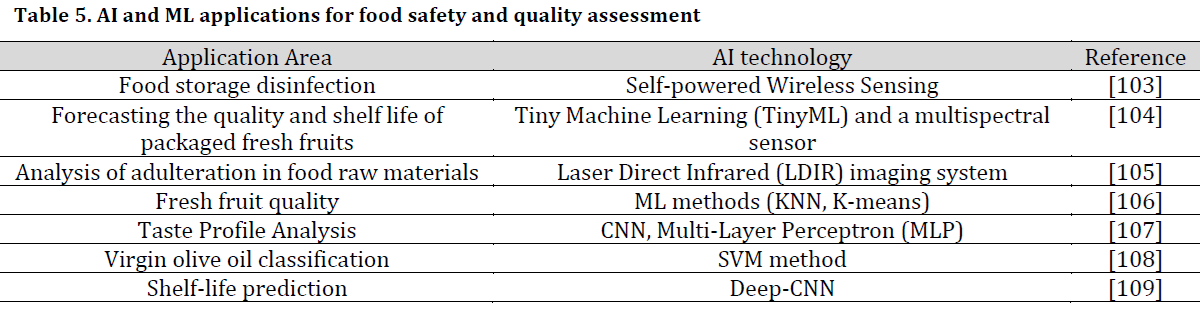
A safe food supply is a crucial factor of food security. However, food supplies are facing an increasing number of risks including microbiological hazards, climate change, and supply chain disorders [5][101][102]. It appears that AI and related technologies have the ability to prevent and monitor these risks from the field to the table (Table 5). By integrating molecular test results with sample metadata, AI enhances source tracking and early risk detection, facilitating the identification of foodborne pathogens before raw materials enter processing [102]. Automated systems can execute quality control and product inspection throughout the processing stage, while machine learning enables the precise analysis of sensory attributes such as taste. Furthermore, optimized storage protocols within managed cold chains facilitate the maintenance of food freshness and the extension of product shelf life [5][101][102]. These innovative technologies will gain wider applications if they are integrated into the existing food safety system successfully.
Biodiversity monitoring using AI technologies
Monitoring biodiversity is a crucial process to understand and safeguard the complex balance and interactions in farm ecosystems. This process involves recording the occurrence, abundance, and distribution of different species, such as plants, insects, birds, and mammals, to evaluate ecosystem’s resilience, and develop sustainable agricultural practices [110]. AI can support biodiversity monitoring in several ways. Image recognition and acoustic monitoring enable rapid and accurate species detection, while remote sensing and unmanned aerial vehicles (UAVs) aid in evaluating habitat quality [110][111]. AI can also provide early warnings of pest and disease outbreaks, triggering specific actions [110][111].
The mentioned applications can be seen through several research works. One study advocates for integrating AI within the European Common Agricultural Policy to address climate and biodiversity challenges [111]. Another work utilized AI-powered deep learning to analyze audio recordings from AudioMoth devices, revealing how different farming practices affect biodiversity [112]. Additionally, studies have demonstrated the utility of affordable drones for mapping plant diversity in woodlands and grasslands [113].
Although monitoring tools are becoming increasingly sophisticated, they are still not implemented widely for agriculture. The expensive equipment, as well as costs related to data analysis, place the technology beyond the reach of most smallholder farmers. Furthermore, linking biodiversity data to practical farm management decisions remains difficult, and detecting pollinator declines will require further research and enhanced extension services.
Agricultural economics and market predictive analytics
Machine learning is also playing an increasingly important role in agricultural economics by supporting more adaptive and predictive models of markets and agricultural production decisions within the context of advanced precision agriculture technologies and highly granular environmental monitoring data [114]. ML methods contribute to enhancing the econometric toolkit by processing high-dimensional observational data with many regressors while also mitigating specification bias that often arises from assuming restrictive functional forms [114]. Regularization and shrinkage techniques help address correlation and high dimensionality by imposing penalty functions that constrain the parameter space and minimize a loss function. These methods typically rely on cross-validation to improve out-of-sample predictive performance [114]. More advanced tools in this class have been successfully applied to characterize price discovery dynamics using long short-term memory (LSTM) networks in corn markets, capturing nonlinear price behavior, short-term shocks, and regime shifts [115]. By estimating these features more accurately, improvements in volatility prediction can potentially improve forecasts of supply chain shocks and reduce uncertainty for investment decisions, especially when seasonality and long-run trend components in commodity price time series are properly accounted for [115][116].
The marriage of field-level agronomic data and backward-looking costs permits econometric and subsequent cost-benefit analysis of individual farmer costs and measures financial returns generated by adopting site-specific management practices [117]. In conjunction with remote sensing, these same predictive tools support a novel form of risk mitigation; fully automated index-based insurance where remote sensing values on index values drive timely claim payment without manual verification [118].
On the macro level, researchers can carry out even more detailed causal inference with the predictive tools, allowing policy makers to simulate and prepare for increasingly dire food security futures in a context of growing environmental turbulence [114][118]. Operationalization over the long term delivers consistent markets and resilient sectors.
Challenges and opportunities of AI/ML in smart farming
Precision farming marks a significant shift from traditional “one-size-fits-all” approaches to data-driven management. By collecting detailed data on soil conditions and crop health, farmers can tailor practices to specific field needs. AI enhances this through automated analysis and predictive insights from sensors and drones [119][120]. However, widespread adoption faces several interrelated challenges.
Data accessibility and integrity remain a fundamental barrier. Access to high‑quality data is limited in many regions, particularly for smaller farms, which impedes the development of effective AI models. Integrating data from diverse sources (sensors, drones, weather stations) also requires standardization, while ensuring accuracy is paramount as errors can have significant consequences [14]. Computational power and infrastructure pose additional hurdles. Analyzing massive datasets requires processing power that may be unavailable to small farms. Reliable internet connectivity is equally essential for real-time processing and data transfer, yet remains lacking in many rural areas [14][119].
Model generalizability presents a technical challenge, since algorithms trained on specific datasets often perform poorly when applied to different environments or crop types. Adapting models to diverse conditions requires extensive data collection and retraining, both costly and time‑consuming processes that limit scalability of developed models [120][121]. On the other hand, cost and adoption barriers are particularly acute for smaller operations. Initial investments in sensors, infrastructure, and software, combined with ongoing expenses for data storage and maintenance, can be prohibitive. The lack of affordable, accessible AI solutions further disadvantages farmers with limited resources [14][121].
Ethical considerations in AI‑driven agricultural applications demand urgent and focused attention. Protecting data privacy and security is a major concern, since farm practices and yield data are susceptible to unauthorized access [121]. Additionally, automation raises concerns about job displacement and socioeconomic effects on rural communities [122]. Environmental implications of AI deployment, from resource use to ecological sustainability, require careful examination [121]. Transparency and accountability in AI-driven practices are essential for fairness [122]. Human-machine interface issues round out the challenges. Building trust in AI systems requires transparency about their operation. Comprehensive farmer training is needed to enable effective use while avoiding over-reliance that might erode traditional agricultural competencies [119]. Addressing these interconnected challenges will require collaborative efforts from researchers, policymakers, and industry to ensure that the benefits of AI in agriculture are both accessible and equitable.
Conclusions
Artificial intelligence and machine learning present significant potential to mitigate critical agricultural challenges, such as climate change, land degradation, water scarcity, supply chain instability, and rising food demand. AI-assisted models have the potential to optimize productivity and resource use efficiency while lowering production costs. However, their implementation necessitates a rigorous evaluation of ethical considerations, including data privacy, labor market shifts, and environmental impacts. It is necessary to have clear and transparent AI applications where users can fully comprehend the system. Well-designed human-machine interfaces and thorough farmer training can build trust and ensure ethical implementation of AI tools at the farm level. The areas where more research needs to focus in the future are developing more explainable AI, enhancing human-machine interaction, and implementing a strong ethical and governance framework that protects rights such as fairness, privacy, and sustainability. The need for a collaborative ecosystem linking researchers, policy makers, industry, and the farmer community would be imperative for fair accessibility of AI tools and mitigation of socio-economic impact.
Conflict of interest statement
The author Dr. Mohsen Abbod is an Editorial Board Member of DYSONA – Applied Science. He was recused from handling this manuscript, which was processed independently by another editor. The authors declare no competing interests.
Funding statement
The authors declared that no funding was received in relation to this manuscript.
Data availability statement
The authors stated that no data was used in the preparation of this manuscript.
References
- Edwards CA. The Importance of Integration in Sustainable Agricultural Systems. In: Sustainable Agricultural Systems. CRC Press. 2020. DOI
- Tian Z, Wang J, Li J, Han B. Designing future crops: challenges and strategies for sustainable agriculture. Plant J. 2021;105(5):1165-78. DOI
- Singh A, Mehrotra R, Rajput VD, Dmitriev P, Singh AK, Kumar P, Tomar RS, Singh O, Singh AK. Geoinformatics, artificial intelligence, sensor technology, big data: emerging modern tools for sustainable agriculture. Sustain. Agric. Syst. Technol. 2022:295-313. DOI
- Padhiary M, Kumar R. Enhancing Agriculture Through AI Vision and Machine Learning. In: Advances in Computational Intelligence and Robotics. IGI Global. 2024. DOI
- Dhal SB, Kar D. Leveraging artificial intelligence and advanced food processing techniques for enhanced food safety, quality, and security: a comprehensive review. Discov. Appl. Sci. 2025;7(1):75. DOI
- Raj EFI, Appadurai M, Athiappan K. Precision Farming in Modern Agriculture. In: Transactions on Computer Systems and Networks. Springer Singapore. 2021. DOI
- Akintuyi OB. Adaptive AI in precision agriculture: A review: Investigating the use of self-learning algorithms in optimizing farm operations based on real-time data. Open Access Res. J. Multidiscip. Stud. 2024;7(2):016-30. DOI
- Angelov PP, Soares EA, Jiang R, Arnold NI, Atkinson PM. Explainable artificial intelligence: an analytical review. WIREs Data Min. Knowl. Discov. 2021;11(5):e1424. DOI
- Blanco-Gonzalez A, Cabezon A, Seco-Gonzalez A, Conde-Torres D, Antelo-Riveiro P, Pineiro A, Garcia-Fandino R. The role of AI in drug discovery: challenges, opportunities, and strategies. Pharmaceuticals. 2023;16(6):891. DOI
- Sha W, Guo Y, Yuan Q, Tang S, Zhang X, Lu S, Guo X, Cao Y, Cheng S. Artificial Intelligence to Power the Future of Materials Science and Engineering. Adv. Intell. Syst. 2020;2(4):1900143. DOI
- Jones A, Kuehnert J, Fraccaro P, Meuriot O, Ishikawa T, Edwards B, Stoyanov N, Remy SL, Weldemariam K, Assefa S. AI for climate impacts: applications in flood risk. npj Clim. Atmos. Sci. 2023;6(1):63. DOI
- Chen L, Chen P, Lin Z. Artificial Intelligence in Education: A Review. IEEE Access 2020;8:75264-78. DOI
- Nosova SS, Norkina AN, Morozov NV. Artificial intelligence and the future of the modern economy. Innov. Invest. 2023(1):240-5.
- Bhat SA, Huang N. Big Data and AI Revolution in Precision Agriculture: Survey and Challenges. IEEE Access 2021;9:110209-22. DOI
- Samuel AL. Some Studies in Machine Learning Using the Game of Checkers. IBM J. Res. Dev. 1959;3(3):210-29. DOI
- Alloghani M, Al-Jumeily D, Mustafina J, Hussain A, Aljaaf AJ. A Systematic Review on Supervised and Unsupervised Machine Learning Algorithms for Data Science. In: Unsupervised and Semi-Supervised Learning. Springer International Publishing. 2019. DOI
- Liakos K, Busato P, Moshou D, Pearson S, Bochtis D. Machine Learning in Agriculture: A Review. Sensors. 2018;18(8):2674. DOI
- Pantanowitz L, Pearce T, Abukhiran I, Hanna M, Wheeler S, Soong TR, Tafti AP, Pantanowitz J, Lu MY, Mahmood F. Nongenerative Artificial Intelligence in Medicine: Advancements and Applications in Supervised and Unsupervised Machine Learning. Mod. Pathol. 2025;38(3):100680. DOI
- Ye L, Arenz C, Lukens JM, Lai Y. Entanglement engineering of optomechanical systems by reinforcement learning. APL Mach. Learn. 2025;3(1):016107. DOI
- Morales EF, Escalante HJ. A brief introduction to supervised, unsupervised, and reinforcement learning. In: Biosignal Processing and Classification Using Computational Learning and Intelligence. Elsevier. 2022. DOI
- Shinde PP, Shah S. A review of machine learning and deep learning applications. In: 2018 Fourth international conference on computing communication control and automation (ICCUBEA). IEEE. 2018. DOI
- Janiesch C, Zschech P, Heinrich K. Machine learning and deep learning. Electron. Mark. 2021;31(3):685-95. DOI
- Sharma R, Kamble SS, Gunasekaran A, Kumar V, Kumar A. A systematic literature review on machine learning applications for sustainable agriculture supply chain performance. Comput. Oper. Res. 2020;119:104926. DOI
- Kundu SG, Ghosh A, Kundu A, G P G. A ML-AI enabled ensemble model for predicting agricultural yield. Cogent Food Agric. 2022;8(1):2085717. DOI
- Morales A, Villalobos FJ. Using machine learning for crop yield prediction in the past or the future. Front. Plant Sci. 2023;14:1128388. DOI
- Boechel T, Policarpo LM, Ramos GDO, da Rosa Righi R, Singh D. Prediction of Harvest Time of Apple Trees: An RNN-Based Approach. Algorithms. 2022;15(3):95. DOI
- Lingwal S, Bhatia KK, Singh M. A novel machine learning approach for rice yield estimation. J. Exp. Theor. Artif. Intell. 2022:1-20. DOI
- Mitra A, Beegum S, Fleisher D, Reddy VR, Sun W, Ray C, Timlin D, Malakar A. Cotton Yield Prediction: A Machine Learning Approach With Field and Synthetic Data. IEEE Access 2024;12:101273-88. DOI
- Nyéki A, Kerepesi C, Daróczy B, Benczúr A, Milics G, Nagy J, Harsányi E, Kovács AJ, Neményi M. Application of spatio-temporal data in site-specific maize yield prediction with machine learning methods. Precis. Agric. 2021;22(5):1397-415. DOI
- Whitmire CD, Vance JM, Rasheed HK, Missaoui A, Rasheed KM, Maier FW. Using Machine Learning and Feature Selection for Alfalfa Yield Prediction. AI. 2021;2(1):71-88. DOI
- Suescún MF. Machine learning approaches for tomato crop yield prediction in precision agriculture. MSc. Thesis, Universidade NOVA de Lisboa (Portugal). 2021
- Pantazi X, Moshou D, Alexandridis T, Whetton R, Mouazen A. Wheat yield prediction using machine learning and advanced sensing techniques. Comput. Electron. Agric. 2016;121:57-65. DOI
- Pathmanaban P, Gnanavel BK, Anandan SS, Sathiyamurthy S. Advancing post-harvest fruit handling through AI-based thermal imaging: applications, challenges, and future trends. Discov. Food. 2023;3(1):27. DOI
- Wieme J, Mollazade K, Malounas I, Zude-Sasse M, Zhao M, Gowen A, Argyropoulos D, Fountas S, Van Beek J. Application of hyperspectral imaging systems and artificial intelligence for quality assessment of fruit, vegetables and mushrooms: A review. Biosyst. Eng. 2022;222:156-76. DOI
- Wei Z, Liu H, Xu J, Li Y, Hu J, Tian S. Quality grading method for Pleurotus eryngii during postharvest storage based on hyperspectral imaging and multiple quality indicators. Food Control. 2024;166:110763. DOI
- Huang W, Wang X, Zhang J, Xia J, Zhang X. Improvement of blueberry freshness prediction based on machine learning and multi-source sensing in the cold chain logistics. Food Control. 2023;145:109496. DOI
- Eftekhari M, Ma C, Orlov YL. Editorial: Applications of artificial intelligence, machine learning, and deep learning in plant breeding. Front. Plant Sci. 2024;15:1420938. DOI
- Hamazaki K, Iwata H. AI-assisted selection of mating pairs through simulation-based optimized progeny allocation strategies in plant breeding. Front. Plant Sci. 2024;15:1361894. DOI
- Farooq MA, Gao S, Hassan MA, Huang Z, Rasheed A, Hearne S, Prasanna B, Li X, Li H. Artificial intelligence in plant breeding. Trends Genet. 2024;40(10):891-908. DOI
- Mukherjee R, Ghosh A, Chakraborty C, De JN, Mishra DP. Rice leaf disease identification and classification using machine learning techniques: A comprehensive review. Eng. Appl. Artif. Intell. 2025;139:109639. DOI
- González-Rodríguez VE, Izquierdo-Bueno I, Cantoral JM, Carbú M, Garrido C. Artificial intelligence: a promising tool for application in phytopathology. Horticulturae. 2024;10(3):197. DOI
- Jafar A, Bibi N, Naqvi RA, Sadeghi-Niaraki A, Jeong D. Revolutionizing agriculture with artificial intelligence: plant disease detection methods, applications, and their limitations. Front. Plant Sci. 2024;15:1356260. DOI
- Bhuyan P, Singh PK, Das SK. Crop Health Monitoring Through AI-Based Crop Leaf Disease Detection Systems. In: Advances in Environmental Engineering and Green Technologies. IGI Global. 2025. DOI
- Abdu AM, Mokji MMM, Sheikh UUU. Machine learning for plant disease detection: an investigative comparison between support vector machine and deep learning. IAES Int. J. Artif. Intell. 2020;9(4):670. DOI
- Mekha P, Teeyasuksaet N. Image classification of rice leaf diseases using random forest algorithm. In: 2021 joint international conference on digital arts, media and technology with ECTI northern section conference on electrical, electronics, computer and telecommunication engineering. IEEE. 2021:165-9. DOI
- Joseph DS, Pawar PM, Pramanik R. Intelligent plant disease diagnosis using convolutional neural network: a review. Multimedia Tools Appl. 2022;82(14):21415-81. DOI
- Sangeetha R, Logeshwaran J, Rocher J, Lloret J. An Improved Agro Deep Learning Model for Detection of Panama Wilts Disease in Banana Leaves. AgriEngineering. 2023;5(2):660-79. DOI
- Dent D, Binks RH. Insect pest management. CABI. 2020. DOI
- Bjerge K, Alison J, Dyrmann M, Frigaard CE, Mann HMR, Høye TT. Accurate detection and identification of insects from camera trap images with deep learning. PLOS Sustain. Transform. 2023;2(3):e0000051. DOI
- Ahmad Loti NN, Mohd Noor MR, Chang S. Integrated analysis of machine learning and deep learning in chili pest and disease identification. J. Sci. Food Agric. 2020;101(9):3582-94. DOI
- Radicetti E, Mancinelli R. Sustainable Weed Control in the Agro-Ecosystems. Sustainability. 2021;13(15):8639. DOI
- García-Navarrete OL, Correa-Guimaraes A, Navas-Gracia LM. Application of Convolutional Neural Networks in Weed Detection and Identification: A Systematic Review. Agriculture. 2024;14(4):568. DOI
- León Gutiérrez L, Castillo Rosales D, Tay Neves K, Bustos Turu G. Artificial Intelligence and Agronomy: An Introductory Reflection on Reducing Herbicide Dependence in Weed Management. In: Weed Management – Global Strategies. IntechOpen. 2024. DOI
- Abbod M, Mohammad A. Combined interaction of fungicides binary mixtures: experimental study and machine learning-driven QSAR modeling. Sci. Rep. 2024;14(1):12700. DOI
- Anandhi G, Iyapparaja M. Systematic approaches to machine learning models for predicting pesticide toxicity. Heliyon. 2024;10(7):e28752. DOI
- Rahimi-Soujeh Z, Safaie N, Moradi S, Abbod M, Sharifi R, Mojerlou S, Mokhtassi-Bidgoli A. New binary mixtures of fungicides against Macrophomina phaseolina: Machine learning-driven QSAR, read-across prediction, and molecular dynamics simulation. Chemosphere. 2024;366:143533. DOI
- Chatterjee M, Banerjee A, Tosi S, Carnesecchi E, Benfenati E, Roy K. Machine learning – based q-RASAR modeling to predict acute contact toxicity of binary organic pesticide mixtures in honey bees. J. Hazard. Mater. 2023;460:132358. DOI
- Nigus EA, Taye GB, Girmaw DW, Salau AO. Development of a Model for Detection and Grading of Stem Rust in Wheat Using Deep Learning. Multimed. Tools Appl. 2023;83(16):47649-76. DOI
- Ait Nasser A, Akhloufi MA. A Hybrid Deep Learning Architecture for Apple Foliar Disease Detection. Computers. 2024;13(5):116. DOI
- Abd Manaf MNH, Juraimi AS, Motmainna M, Che’Ya NN, Mat Su AS, Mohd Roslim MH, Ahmad A, Mohd Noor N. Detection of Sedge Weeds Infestation in Wetland Rice Cultivation Using Hyperspectral Images and Artificial Intelligence: A Review. Pertanika J. Sci. Technol. 2024;32(3):1317-34. DOI
- Márquez MS, Garibaldi SF. RGB and multispectral image analysis based on deep learning for real.-time detection and control of weeds in cornfields. MSc Thesis. Centro de Investigaciones en Óptica, A.C. (CIO). 2024.
- Christakakis P, Papadopoulou G, Mikos G, Kalogiannidis N, Ioannidis D, Tzovaras D, Pechlivani EM. Smartphone-Based Citizen Science Tool for Plant Disease and Insect Pest Detection Using Artificial Intelligence. Technologies. 2024;12(7):101. DOI
- Kargar A, Zorbas D, Gaffney M, O’Flynn B, Tedesco S. Y-Net: Insect Counting and Segmentation using Deep Learning on Embedded Devices. In: 2024 IEEE International Instrumentation and Measurement Technology Conference (I2MTC). IEEE. 2024. DOI
- El Akhal H, Ben Yahya A, Moussa N, El Belrhiti El Alaoui A. A novel approach for image-based olive leaf diseases classification using a deep hybrid model. Ecol. Inform. 2023;77:102276. DOI
- Firmansyah E, Suparyanto T, Ahmad Hidayat A, Pardamean B. Real-time Weed Identification Using Machine Learning and Image Processing in Oil Palm Plantations. IOP Conf. Ser.: Earth Environ. Sci 2022;998(1):012046. DOI
- Hossen MH, Mohibullah M, Chowdhury SM, Ahmed T, Acharjee S, Panna MB. Wheat diseases detection and classification using convolutional neural network (CNN). Int. J. Adv. Comput. Sci. Appl. 2022;13(11).
- Müller DB, Vogel C, Bai Y, Vorholt JA. The Plant Microbiota: Systems-Level Insights and Perspectives. Annu. Rev. Genet. 2016;50(1):211-34. DOI
- Deng Z, Zhang J, Li J, Zhang X. Application of Deep Learning in Plant–Microbiota Association Analysis. Front. Genet. 2021;12:697090. DOI
- Zhao L, Walkowiak S, Fernando WGD. Artificial Intelligence: A Promising Tool in Exploring the Phytomicrobiome in Managing Disease and Promoting Plant Health. Plants. 2023;12(9):1852. DOI
- de Souza RSC, Armanhi JSL, Arruda P. From Microbiome to Traits: Designing Synthetic Microbial Communities for Improved Crop Resiliency. Front. Plant Sci. 2020;11:1179. DOI
- Liu H, Zhao Z, Li H, Yu S, Cong L, Ding L, Ran C, Wang X. Accurate prediction of huanglongbing occurrence in citrus plants by machine learning-based analysis of symbiotic bacteria. Front. Plant Sci. 2023;14:1129508. DOI
- Hagen M, Dass R, Westhues C, Blom J, Schultheiss SJ, Patz S. Interpretable machine learning decodes soil microbiome’s response to drought stress. Environ. Microbiome. 2024;19(1):35. DOI
- Grunwald S. Artificial intelligence and soil carbon modeling demystified: power, potentials, and perils. Carbon Footpr. 2022;1(1):6. DOI
- Emadi M, Taghizadeh-Mehrjardi R, Cherati A, Danesh M, Mosavi A, Scholten T. Predicting and Mapping of Soil Organic Carbon Using Machine Learning Algorithms in Northern Iran. Remote Sens. 2020;12(14):2234. DOI
- Sakthivel S, Vivekanandhan V, Manikandan M. Automated Irrigation System Using Improved Fuzzy Neural Network in Wireless Sensor Networks. Intell. Autom. Soft Comput. 2023;35(1):853-66. DOI
- Gholami V, Sahour H, Hadian Amri MA. Soil erosion modeling using erosion pins and artificial neural networks. CATENA. 2021;196:104902. DOI
- Jain S, Sethia D. A Review on Applications of Artificial Intelligence for Identifying Soil Nutrients. In: Communications in Computer and Information Science. Springer Nature Switzerland. 2023. DOI
- Lanjewar MG, Gurav OL. Convolutional Neural Networks based classifications of soil images. Multimed. Tools Appl. 2022;81(7):10313-36. DOI
- Motia S, Reddy S. Exploration of machine learning methods for prediction and assessment of soil properties for agricultural soil management: a quantitative evaluation. J. Phys. Conf. Ser. 2021;1950(1):012037. DOI
- Veeramanju KT. Predictive Models for Optimal Irrigation Scheduling and Water Management: A Review of AI and ML Approaches. Int. J. Manag. Technol. Soc. Sci. 2024:94-110. DOI
- Mustafa HM, Mustapha A, Hayder G, Salisu A. Applications of IoT and artificial intelligence in water quality monitoring and prediction: A review. In: 2021 6th international conference on inventive computation technologies (ICICT). IEEE. 2021:968-75. DOI
- Sabamehr M, Ekin CÇ. AI-driven drought management system: a Turkish case study. In: 2023 4th International Informatics and Software Engineering Conference (IISEC). IEEE. 2023. DOI
- Motta M, de Castro Neto M, Sarmento P. A mixed approach for urban flood prediction using Machine Learning and GIS. Int. J. Disaster Risk Reduct. 2021;56:102154. DOI
- Hu T, Zhang X, Bohrer G, Liu Y, Zhou Y, Martin J, Li Y, Zhao K. Crop yield prediction via explainable AI and interpretable machine learning: Dangers of black box models for evaluating climate change impacts on crop yield. Agric. For. Meteorol. 2023;336:109458. DOI
- Hamdan A, Ibekwe KI, Etukudoh EA, Umoh AA, Ilojianya VI. AI and machine learning in climate change research: A review of predictive models and environmental impact. World J. Adv. Res. Rev. 2024;21(1):1999-2008. DOI
- Faid A, Sadik M, Sabir E. An Agile AI and IoT-Augmented Smart Farming: A Cost-Effective Cognitive Weather Station. Agriculture. 2021;12(1):35. DOI
- Hasan R, Farabi SF, Kamruzzaman M, BHUYAN MK, Nilima SI. AI-Driven Strategies for Reducing Deforestation. Am. J. Eng. Technol. 2024;6(6):6-20. DOI
- Yao P, Yu Z, Zhang Y, Xu T. Application of machine learning in carbon capture and storage: An in-depth insight from the perspective of geoscience. Fuel. 2023;333:126296. DOI
- Neethirajan S. The role of sensors, big data and machine learning in modern animal farming. Sens. Bio-Sens. Res. 2020;29:100367. DOI
- Alipio M, Villena ML. Intelligent wearable devices and biosensors for monitoring cattle health conditions: A review and classification. Smart Health. 2023;27:100369. DOI
- Malhotra M, Jaiswar A, Shukla A, Rai N, Bedi A, Iquebal MA, Jaiswal S, Kumar D, Rai A. Application of AI/ML Approaches for Livestock Improvement and Management. In: Livestock Diseases and Management. Springer Nature Singapore. 2023. DOI
- Olasehinde O. Infrared thermography and machine learning in livestock production. Int. J. Adv. Res. Rev. 2021;6:38-57.
- Öztürk A, Allahverdi N, Saday F. Application of artificial intelligence methods for bovine gender prediction. Turk. J. Eng. 2022;6(1):54-62. DOI
- Brahma B, Patra N, Parida SK, Pani SK. Chicken Gender fixation using Machine Learning Techniques. Afr. J. Bio. Sci. 2024;6(Si3).
- Dilaver H, Dilaver KF. Robotics systems and artificial intelligence applications in livestock farming. J. Anim. Sci. Econ. 2024;3(2):63-72.
- Fuentes S, Gonzalez Viejo C, Cullen B, Tongson E, Chauhan SS, Dunshea FR. Artificial Intelligence Applied to a Robotic Dairy Farm to Model Milk Productivity and Quality based on Cow Data and Daily Environmental Parameters. Sensors. 2020;20(10):2975. DOI
- Hu W, Chen L, Wang B, Li G, Huang X. Design and Implementation of a Full-Time Artificial Intelligence of Things-Based Water Quality Inspection and Prediction System for Intelligent Aquaculture. IEEE Sens. J. 2024;24(3):3811-21. DOI
- Ahmed MS, Jeba SM. SalmonScan: A novel image dataset for machine learning and deep learning analysis in fish disease detection in aquaculture. Data Brief. 2024;54:110388. DOI
- Hu W, Chen L, Huang B, Lin H. A Computer Vision-Based Intelligent Fish Feeding System Using Deep Learning Techniques for Aquaculture. IEEE Sens. J. 2022;22(7):7185-94. DOI
- Ubina NA, Lan H, Cheng S, Chang C, Lin S, Zhang K, Lu H, Cheng C, Hsieh Y. Digital twin-based intelligent fish farming with Artificial Intelligence Internet of Things (AIoT). Smart Agric. Technol. 2023;5:100285. DOI
- Karanth S, Benefo EO, Patra D, Pradhan AK. Importance of artificial intelligence in evaluating climate change and food safety risk. J. Agric. Food Res. 2023;11:100485. DOI
- Qian C, Murphy S, Orsi R, Wiedmann M. How Can AI Help Improve Food Safety?. Annu. Rev. Food Sci. Technol. 2023;14(1):517-38. DOI
- Chen X, Song D, Wan Z, Zhang R, Wu Z, Xiao X. Light energy harvested flexible wireless sensing for disinfection sterilization in food storage. Sustain. Energy Technol. Assess. 2024;70:103952. DOI
- Mohammed M, Srinivasagan R, Alzahrani A, Alqahtani NK. Machine-Learning-Based Spectroscopic Technique for Non-Destructive Estimation of Shelf Life and Quality of Fresh Fruits Packaged under Modified Atmospheres. Sustainability. 2023;15(17):12871. DOI
- da Costa Filho PA, Cobuccio L, Mainali D, Rault M, Cavin C. Rapid analysis of food raw materials adulteration using laser direct infrared spectroscopy and imaging. Food Control. 2020;113:107114. DOI
- Nerkar PM, Shinde SS, Liyakat KK, Desai S, Kazi SS. Monitoring fresh fruit and food using Iot and machine learning to improve food safety and quality. Tuijin Jishu/J. Propuls. Technol. 2023;44(3):2927-31.
- Bo W, Qin D, Zheng X, Wang Y, Ding B, Li Y, Liang G. Prediction of bitterant and sweetener using structure-taste relationship models based on an artificial neural network. Food Res. Int. 2022;153:110974. DOI
- Lu C, Li B, Jing Q, Pei D, Huang X. A classification and identification model of extra virgin olive oil adulterated with other edible oils based on pigment compositions and support vector machine. Food Chem. 2023;420:136161. DOI
- Dutta J, Deshpande P, Rai B. AI-based soft-sensor for shelf life prediction of ‘Kesar’ mango. SN Appl. Sci. 2021;3(6):657. DOI
- Shivaprakash KN, Swami N, Mysorekar S, Arora R, Gangadharan A, Vohra K, Jadeyegowda M, Kiesecker JM. Potential for Artificial Intelligence (AI) and Machine Learning (ML) Applications in Biodiversity Conservation, Managing Forests, and Related Services in India. Sustainability. 2022;14(12):7154. DOI
- Garske B, Bau A, Ekardt F. Digitalization and AI in European Agriculture: A Strategy for Achieving Climate and Biodiversity Targets?. Sustainability. 2021;13(9):4652. DOI
- Abeßer J, Wang X, Bänsch S, Scherber C, Lukashevich H. Analyzing Bird and Bat Activity in Agricultural Environments using AI-driven Audio Monitoring. Fortschritte der Akustik–DAGA. 2022;48:123-6.
- Sângeorzan DD, Rotar I. Evaluating Plant Biodiversity in Natural and Semi‑Natural Areas with the Help of Aerial Drones. Bull. Univ. Agric. Sci. Vet. Med. Cluj-Napoca Agric. 2020;77(2):64-8. DOI
- Storm H, Baylis K, Heckelei T. Machine learning in agricultural and applied economics. Eur. Rev. Agric. Econ. 2019;47(3):849-92. DOI
- Brignoli PL, Varacca A, Gardebroek C, Sckokai P. Machine learning to predict grains futures prices. Agric. Econ. 2024;55(3):479-97. DOI
- Krishna PA, Narayana GV, Kotha SK, Pattnayak D. Machine Learning Based Agricultural Price Forecasting for Major Food Crops in India Using Environmental and Economic Factors. In: Biology and Life Sciences Forum. MDPI. 2026;54(1):7. DOI
- Finger R, Swinton SM, El Benni N, Walter A. Precision Farming at the Nexus of Agricultural Production and the Environment. Annu. Rev. Resour. Econ. 2019;11(1):313-35. DOI
- Benami E, Jin Z, Carter MR, Ghosh A, Hijmans RJ, Hobbs A, Kenduiywo B, Lobell DB. Uniting remote sensing, crop modelling and economics for agricultural risk management. Nat. Rev. Earth Environ. 2021;2(2):140-59. DOI
- Araújo SO, Peres RS, Ramalho JC, Lidon F, Barata J. Machine Learning Applications in Agriculture: Current Trends, Challenges, and Future Perspectives. Agronomy. 2023;13(12):2976. DOI
- Senoo EEK, Anggraini L, Kumi JA, Karolina LB, Akansah E, Sulyman HA, Mendonça I, Aritsugi M. IoT Solutions with Artificial Intelligence Technologies for Precision Agriculture: Definitions, Applications, Challenges, and Opportunities. Electronics. 2024;13(10):1894. DOI
- Sharma A, Sharma A, Tselykh A, Bozhenyuk A, Choudhury T, Alomar MA, Sánchez-Chero M. Artificial intelligence and internet of things oriented sustainable precision farming: Towards modern agriculture. Open Life Sci. 2023;18(1):20220713. DOI
- Bazargani K, Deemyad T. Automation’s Impact on Agriculture: Opportunities, Challenges, and Economic Effects. Robotics. 2024;13(2):33. DOI
Cite this article:
Abbod M, Safaie N, Hussein SN. Artificial intelligence and machine learning in agri-food systems: A comprehensive review of technological frontiers, socio-ethical barriers, and future roadmaps. DYSONA-Applied Science. 2027;8(1):17-32. doi: 10.30493/das.2026.010708