Issa Barakat 1*; Adib Saad 2; Ibrahem Nisafi 1
1, Department of Forestry and Ecology, Faculty of Agriculture, Latakia University, Lattakia, Syria
2, Scientific research and publishing Directorate, Manara University, Lattakia,Syria
E-mail:
issa.barakat@latakia-univ.edu.sy
Received: 16/03/2026
Acceptance: 18/06/2026
Available Online: 19/06/2026
Published: 01/07/2026
Manuscript link
http://dx.doi.org/10.30493/DAS.2026.011906
Abstract
Nutritional composition and heavy metal contamination within the muscle tissue of Liza auratus were investigated by this research. Specimens were collected from the Syrian coastal waters of Latakia Governorate during 2022 to facilitate an evaluation of corresponding human health threats. The micro-Kjeldahl method and ethyl ether extraction established the protein and fat profiles. Concurrently, atomic absorption spectrometry quantified the levels of cadmium (Cd), nickel (Ni), copper (Cu), and lead (Pb). Target hazard quotient (THQ), hazard index (HI), and carcinogenic risk (CR) metrics framed the assessment of potential health dangers. Pearson’s correlation and principal component analysis (PCA) guided the subsequent statistical review. Averages of 19.3 g/100g for protein and 5.2 g/100g for fat were yielded by the nutritional breakdown, while mean heavy metal concentrations were 0.073 mg/kg for cadmium (Cd), 1.228 mg/kg for nickel (Ni), 2.628 mg/kg for copper (Cu), and 0.98 mg/kg for lead (Pb). An absence of notable non-carcinogenic threats was confirmed by THQ outputs falling beneath 1 (0.05 to 0.58) alongside an HI of 0.30. Similarly, the CR estimates for Cd (7.5×10⁻⁶) and Pb (2.1×10⁻⁷) were within the established USEPA safe boundaries (10⁻⁶-10⁻⁴). Size-dependent bioaccumulation affecting Pb (r=0.75) and Cu (r=0.72) was exposed through correlation testing. Furthermore, a distinct degradation of dietary quality caused by chemical exposure is implied by inverse relationships between protein density and heavy metals, primarily Cd (r=-0.80) and Pb (r=-0.68). Moderate dietary intake of L. auratus from this territory currently presents negligible physiological danger to consumers. Regardless, the negative link tying metallic accumulation to nutritional decline firmly justifies continuous surveillance of local ecological conditions.
Keywords: Liza auratus, Heavy metals, Protein, Lipid, Lead (Pb)
Introduction
Fish and related derivatives fundamentally contribute to supporting many aspects of healthy human nutrition, particularly for individuals who abstain from red meat, as well as for those with weakened immune systems, malnutrition, or for women during pregnancy and breastfeeding [1]. Fish is an important source of easily absorbed protein. It also contains fats, fat-soluble vitamins, essential amino acids, trace elements, and long-chain polyunsaturated fatty acids from the omega-3 group [1]. Including fish in the diet may also help prevent several diseases, including cancer, heart disease, high blood pressure, Alzheimer’s disease, and inflammatory diseases [2].
The biochemical composition of fish muscles is greatly affected by several factors, including species, reproductive stage, age, degree of sexual maturity, feeding zone, sex, climate, season, and muscle type, which leads to clear variation in this composition [3]. Since fish muscles are the primary component considered for human nutrition, they represent an excellent indicator for assessing the health risks associated with heavy metal contamination [4]. Excess amounts of elements such as nickel (Ni) and copper (Cu) can pose a risk to human health, even though they are essential for certain biochemical processes within living organisms. Moreover, heavy metals such as lead (Pb) and cadmium (Cd) may cause serious health problems even when consumed at low concentrations. Due to their high bioaccumulation rate, these two metals are among the most toxic heavy metals to aquatic organisms [5]. Consequently, consuming fish originating from highly polluted aquatic environments may pose a risk to human health [6]. Thus, fish can be considered valuable bioindicators of environmental pollutants due to the accumulation of minerals in their tissues, particularly in the muscles [7].
Toxicity triggered by heavy metals in fish involves several aspects. Toxic heavy metals in dissolved form can accumulate in aquatic organisms through circulation, leading to several complications in their health and physiological function [8]. Non-essential heavy metals and essential metals that exceed permissible limits accumulate in various organs, such as the gills, liver, kidneys, muscle, intestine, skin, and bones [9]. Heavy metals bind with biological particles containing nitrogen, sulfur, and oxygen, thereby altering the structure and function of proteins, lipids, enzymes, and hormones, which ultimately damages various organs in fish [10]. These metals also cause oxidative degradation of biomolecules (DNA, proteins, and lipids) through the generation of free radicals [11][12]. Heavy metal accumulation in fish disrupts protein structure, leading to decreased protein content and altered function, while simultaneously affecting lipid metabolism, often causing changes in fat content (either accumulation or depletion, depending on the metal and species), and generating harmful oxidative stress, ultimately impacting fish health, growth, and nutritional quality for humans [13]. For instance, a rise in serum total protein and globulin, coupled with a decline in albumin, was observed in Cyprinus carpio following intoxication with copper and nickel [14]. Consistent results for muscle total protein were additionally observed in Mystus cavasius [15]. Other studies have also indicated a decrease in total protein in Oreochromis niloticus [16] associated with heavy metal poisoning. Studies have shown that cadmium (Cd) accumulation in fish leads to a significant decrease in their lipid and protein content. This is attributed to metabolic disturbances, tissue damage, and increased energy expenditure as the fish attempt to adapt to the toxicity of this metal [17]. The accumulation of cadmium disrupts normal fat metabolism, leading to a decrease in total fat content in fish tissues, particularly in the muscles, liver, and gills [18]. It was also found that cadmium accumulation leads to decreased protein levels in various tissues, especially muscle tissue, due to increased protein breakdown and impaired protein synthesis [19]. The accumulation of nickel in fish also has detrimental effects on both their protein and fat (lipid) content, mainly due to the stimulation of oxidative stress and disruption of metabolic processes [20]. Accumulation of nickel to critical levels alters protein metabolism, causing abnormalities in normal protein levels in various fish tissues, particularly in the blood, liver, and muscles [21]. It also significantly affects lipid synthesis and metabolism, primarily by promoting lipid peroxidation (oxidative lipid damage) [20]. Studies have also shown that copper accumulation can lead to a significant decrease in the total fat content of fish tissues, particularly in the liver and the body as a whole. This effect is primarily attributed to the inhibition of lipogenesis, increased lipolysis and oxidation, and a decrease in triglyceride levels [22]. Finally, the accumulation of lead (Pb) in fish tissues can lead to a real change in their fat and protein content, mainly causing a decrease in their total levels in the main tissues due to metabolic disturbance, increased oxidative stress, and organ damage [23].
The golden grey mullet (Liza auratus) is considered economically important for local consumers in Syria and is often caught from polluted environments, which may negatively affect its nutritional value and the content of major nutrients (total proteins and total fats) in its muscles. Given the economic importance of this species and the lack of studies regarding the subject, the aim of the present study is to determine whether a relationship exists between the accumulation of selected heavy metals (cadmium, nickel, copper, and lead) in the muscles of Liza auratus and their nutrient content.
Materials and Methods
Study area and sample preparation
Samples were collected in 2022 from multiple locations to ensure comprehensive coastal coverage of the study area in the marine waters of Latakia Governorate. Fish samples were collected randomly, with 15 to 20 fish obtained from each site, immediately placed on ice, and transported to the laboratory the same day. The total length of each specimen was measured. Scales and skin were then removed, and muscle tissue was separated from the bone and stored at -14°C until analysis [24].
Chemical analysis
Fat
Muscle tissue was dried in an oven at 105°C until a constant weight was achieved. For fat content estimation, the dried samples (1 g each) remaining after moisture determination were finely ground. Fat was extracted using a Soxhlet apparatus with ethyl ether (75 mL) as a nonpolar solvent for five hours. Following extraction, the solvent was evaporated, and the extracted material was weighed [25]. The fat content percentage (g/100g) was calculated as follows:

Protein
The protein content of the fish muscle was determined using the micro-Kjeldahl method. This method involves the conversion of organic nitrogen to ammonium sulfate through digestion with concentrated sulfuric acid (96%, 4 mL) in a micro-Kjeldahl flask. The digest was then diluted, rendered alkaline with sodium hydroxide, and distilled. The liberated ammonia was collected in a boric acid solution and determined titrimetrically [25]. The protein percentage in the sample was calculated using the following equation:

Where:
a: sample weight (g) with a dry sample equivalent to 1 g of fresh sample used in each assay (~0.2 g dried and powdered tissue sample)
b: volume of NaOH required for back titration and neutralize 25ml of 0.1N H2SO4 (for sample)
c: volume of NaOH required for back titration and neutralize 25ml of 0.1N H2SO4 (for blank)
d: normality of NaOH used for titration
6.25: conversion factor of N to protein
14: atomic weight of N
Heavy elements assessment
To estimate heavy metal (Cd, Ni, Cu, and Pb) content in fish muscle, tissue was separated from bone, and 3 grams underwent acid digestion using concentrated ultrapure nitric acid (HNO₃). The samples were placed in digestion flasks containing 5 mL of nitric acid and heated on an electric stove until the solution turned pale yellow or nearly colorless [24]. After digestion, the samples were transferred to 25 mL volumetric flasks and diluted twice with distilled water. The resulting solutions were then filtered using filter paper [24]. Then, digested samples as well as blank (reference) samples were analyzed using an atomic absorption spectrometer (Shimadzu AA-6800) [26].
Evaluation of potential human health
Non‑carcinogenic hazard (THQ)
Non-cancer risks to human health from exposure to heavy metals are quantified using the target hazard quotient (THQ). The ratio of the exposure dose to the reference dose (RfD) is a valuable tool for assessing the risks of metal pollution [27]. According to USEPA [28], the THQ concentration was calculated using the following formula:

FDC is the average daily intake of fish muscle (g/person/day) was estimated between 64 and 200 g/day for normal and regular consumers, respectively [5]. Ef represents the number of exposure events per year, ED is the number of years exposed, Cm is the concentration of heavy metals in the studied sample (µg/g wet weight), TA is the average exposure duration in years, BW is the average body weight of an adult in Syria, and RfD is the reference dose. Based on this equation, a THQ value < 1 indicates no significant non-carcinogenic hazard to human health, while a THQ > 1 is considered potentially hazardous.
Hazard index (HI)
The total hazard quotient, or hazard index (HI), is the sum of the target hazard quotients (THQs) for all heavy metals analyzed in a particular species. The HI estimates the cumulative risk associated with exposure to multiple heavy metals [28]. The HI was calculated by summing the THQ values for each heavy metal in each species using the following formula:
HI = THQCd + THQPb + THQCu + THQNi
When the HI>1, there may be a concern for potential health risks [29].
The carcinogenic risk (CR)
To estimate the lifetime probability of cancer occurrence in individuals resulting from exposure to carcinogenic factors, the carcinogenic risk (CR) factor is calculated. The acceptable range for cancer risk lies between 10⁻⁴ and 10⁻⁶; CR values exceeding 10⁻⁴ are likely to increase the probability of a carcinogenic effect [30]. The cancer risk for cadmium and lead was calculated using the following equation:

where EF represents exposure frequency (days/year), ED denotes exposure duration (years), and TA is the averaging time for non-carcinogenic effects, calculated as EF×ED (days). CSF refers to the Cancer Slope Factor for carcinogenic agents (mg/kg/day), which quantifies the probability of cancer response per unit dose. For the purposes of this study, CSF values were obtained for lead (0.0085 mg/kg/day) and cadmium (1.5 mg/kg/day) from the U.S. Environmental Protection Agency’s (U.S. EPA) Integrated Risk Information System (IRIS) database [28]. EDI represents the Estimated Daily Intake (mg/kg/day).
Statistical analysis
The relationship between the results and influencing factors was examined using Pearson’s correlation test. The study utilized Principal Component Analysis (PCA) to examine the relationships between the chemical compositions of fish and metals.
Results and Discussion
Table 1 presents the total protein and total fat content in the muscle tissue of the studied species, along with the average concentrations of heavy metals. The average protein content in the muscle tissue of the studied species was 19.3 g/100g, which is consistent with previous findings [31] but differs from other studies [32] that reported a value of 10.26 g/100g for the same species. In contrast, Mugil cephalus, a species within the same family, exhibited a protein content of 23.96 g/100g. Similarly, muscle fat content varied from previous studies, whether for the same species or for species within the same family. Specifically, the average muscle fat content of L. auratus in the present study was 5.2 g/100g, which diverges from values reported in earlier research. These findings suggest that the chemical composition of L. auratus may have been influenced by environmental factors [33].
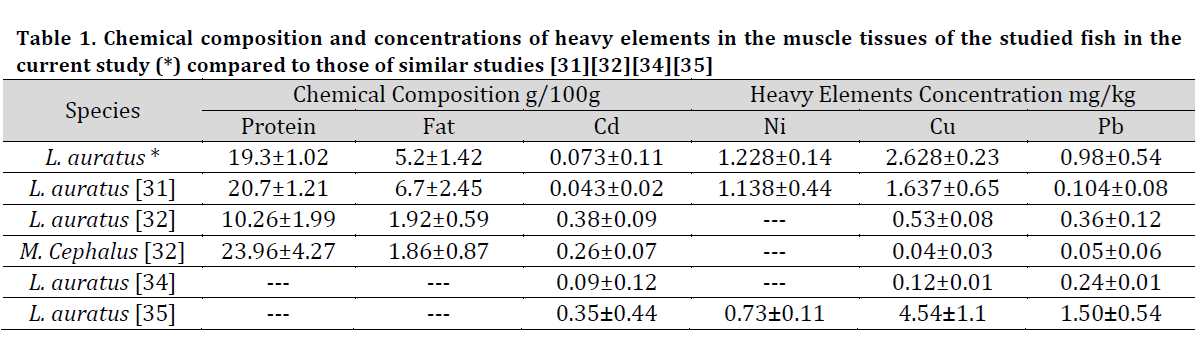
Analytical measurements for L. auratus revealed 0.073 mg/kg of cadmium and 1.228 mg/kg of nickel. Furthermore, copper and lead levels reached 2.628 mg/kg and 0.98 mg/kg, respectively. Historical data regarding this specific organism show distinct variations from these current figures. Similar discrepancies are also noted when comparing these results to related taxonomic families (Table 1). Estuaries and their surrounding zones are primarily occupied by the Golden Grey Mullet (L. auratus). A heightened vulnerability to heavy metal accumulation affects organisms residing within these specific habitats. Open-water marine life experiences lower risks in comparison. Several interconnected variables linked to estuarine dynamics drive this increased susceptibility. The boundary where riverine freshwater encounters seawater forms an estuary. Local physicochemical properties, particularly pH and salinity, shift significantly when these differing water masses blend. This blending triggers the precipitation of dissolved heavy metals via agglomeration. Fine bottom sediments, such as mud and silt, ultimately capture and confine the resulting metal-dense particles. Natural catchments are effectively created by these coastal systems. Industrial, agricultural, and municipal pollutants transported by rivers are retained here before entering the open ocean [35]. Contaminants infiltrate estuarine fish through two distinct routes. Continental delivery occurs via river networks, while ocean currents and tides drive marine inputs. Consequently, greater pollution burdens are imposed upon these species than on strictly freshwater or marine organisms [36]. Highly unstable salinity levels also challenge these coastal inhabitants. Osmotic balance is preserved as their gills and kidneys actively regulate ion exchange. However, essential nutrients like calcium and sodium are structurally mirrored by certain heavy metals, including cadmium and zinc through ionic mimicry. Consequently, due to this molecular resemblance, toxic substances readily enter through the same ion channels and transport proteins, resulting in markedly elevated absorption rates of heavy metals [37]. The nutrient-dense estuarine sediments sustain a highly productive food web. This biological network includes phytoplankton, zooplankton, worms, crustaceans, and mollusks. Bioaccumulation initially drives the loading of heavy metals into these lower trophic tiers. The consumption of these smaller organisms by larger fish subsequently transfers the contaminants. Biomagnification then concentrates these pollutants heavily within their tissues, resulting in greater metal burdens ultimately generated at the apex of the food chain [38]. Additionally, extended durations near or directly upon the seabed characterize the behavior of many estuarine fish. They utilize these lower depths primarily for foraging and securing shelter. Sediment-bound heavy metals directly impact these organisms as a result of this bottom-dwelling activity. Exposure frequently occurs via dermal contact or accidental ingestion during routine feeding cycles [39].
The Target Hazard Quotient (THQ) values for the elements copper (Cu), lead (Pb), cadmium (Cd), and nickel (Ni) in the tissues of L. auratus did not exceed the threshold value of 1, registering 0.52, 0.05, 0.153, and 0.58, respectively. This suggests that adverse health effects resulting from exposure to these heavy metals are unlikely (Table 2). Accordingly, the consumption of muscle tissue from L. auratus caught off the coast of Latakia poses no significant risk to public health.

However, individuals who consume these fish in large quantities may remain susceptible to adverse effects arising from the accumulation of lead and cadmium in muscle tissues. To adequately assess the potential harm these contaminants may cause to humans, it is necessary to consider their cumulative impact at the population level, particularly with regard to non-carcinogenic risks [40]. According to the guidelines of the U.S. Environmental Protection Agency (USEPA), a THQ value below 1 (< 1) indicates an absence of risk to human health or the absence of adverse health effects from heavy metals resulting from daily fish consumption [28].
The Hazard Index (HI) values associated with regular consumption of the muscle tissue of the studied fish species were found to be less than 1 (Table 2), indicating no health risk to healthy adults at typical consumption rates. Although body concentrations of cadmium (Cd) and lead (Pb) remain low and may not pose a major health threat when THQ and HI values are below 1, their presence has nevertheless been linked to a wide range of health issues [41][42].
Cancer risk was calculated using the specific cancer slope factors for each metal (Table 2). The rate of fish consumption in the Latakia coastal region fell within safe limits, in accordance with the guidelines issued by the U.S. Environmental Protection Agency (USEPA). It is worth noting that the USEPA has established its acceptable cancer risk criteria within the range of 1.0 × 10⁻⁶ to 1.0 × 10⁻⁴ [28]. This finding aligns with the results of a study by Zaghloul et al. (2024) [32] on the same fish species under nearly identical conditions.
Correlation analysis (Fig. 1) showed a relatively strong positive correlation between total length and the concentrations of lead (r=0.75) and copper (r=0.72). This positive correlation points to size/age-dependent bioaccumulation, wherein metal accumulation within tissues increases as fish size grows and duration of exposure to aquatic pollutants extends. In contrast, cadmium (Cd) exhibited a negligible correlation with length (r=0.03), suggesting that cadmium accumulation in this species does not primarily depend on body size or age but may instead be influenced by other physiological or environmental factors.
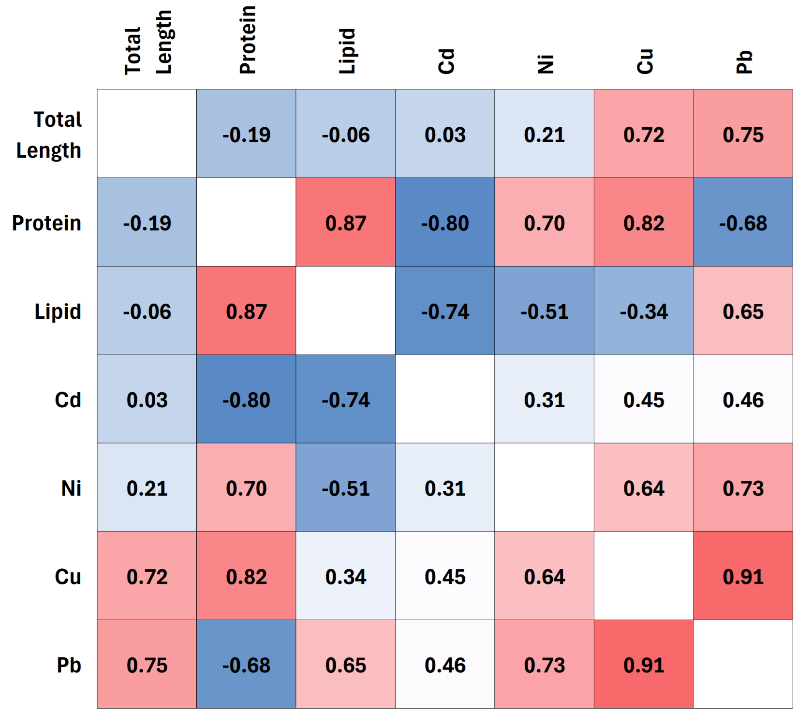
Regarding lipids, a strong positive correlation was observed with lead (r=0.65), along with a strong negative correlation with nickel (r=-0.50). These results reflect the lipophilic properties of certain heavy metal compounds or may indicate the role of adipose tissue as a storage reservoir for some of these elements [43]. The decline in fat content within fish muscle tissue observed alongside rising nickel concentrations can be primarily attributed to nickel-induced generation of reactive oxygen species (ROS). This process induces oxidative stress, which degrades and oxidizes lipids, particularly unsaturated fatty acids, within muscle tissues [44]. Furthermore, nickel accumulation disrupts hepatic function and metabolic processes, compelling the organism to deplete its lipid reserves as an energy source to cope with toxicity, thereby increasing the metabolic cost of survival [44]. Additionally, nickel may cause histological damage, specifically to the gills and liver, impairing the fish’s ability to absorb and store nutrients, which could adversely affect overall lipid content [45].
A strong positive correlation was also observed between protein content and copper (r=0.81). Copper is an essential element that serves as a cofactor in numerous enzymes and metalloproteins, explaining this close association [43]. Regarding interrelationships among metals, a highly significant positive correlation is observed between copper and lead (r=0.91). This typically indicates a common source of contamination for these metals within the sampled environment, or similarity in their chemical behavior and interaction with biological tissues [46]. Furthermore, significant positive correlations were observed between nickel and both copper (r=0.64) and lead (r=0.73), suggesting a common source for this group of metals.
On the other hand, negative correlations were observed between protein content and both cadmium (r=-0.80) and lead (r=-0.68). The decline in muscle protein associated with heavy metal accumulation can be attributed to the disruption of enzymes responsible for protein metabolism. Specifically, ions such as cadmium and lead inhibit the activity of enzymes linked to the metabolism of both proteins and carbohydrates. Consequently, this leads to reduced protein synthesis and disruption of the amino acid recycling pathways within muscle tissues [47][48]. Furthermore, numerous studies have demonstrated that cadmium exposure correlates with elevated levels of free amino acids in muscles, suggesting increased protease activity and accelerated proteolysis, as amino acids are utilized as an energy source to cope with heavy metal-induced toxic stress [48][49]. Moreover, spectroscopic analyses have revealed alterations in protein folding and secondary structure, such as contraction of the α-helix, within muscle tissues following exposure to cadmium and lead, supporting the hypothesis of direct damage to cellular proteins [50].
The results of the present study are in agreement with other studies in which spectral analyses revealed relative increases in lipid content within fish tissues following exposure to lead; however, our findings diverge from those of other studies in which cadmium exposure also resulted in an increase in lipids [50][51]. Consequently, variations in the effects of heavy metal accumulation are linked to multiple factors, including species, pollutant concentration, exposure duration, tissue type, presence of other contaminants, and other environmental influences [50][51].
A study conducted in Algeria investigated trace element accumulation (mercury, nickel, copper, and zinc) in the muscle, liver, and reproductive tissues of three demersal fish species (Pagellus erythrinus, Merluccius merluccius, and Mullus barbatus) collected from five coastal bays. Biochemical analysis revealed significant variation among species, with protein, lipid, and carbohydrate levels differing across tissues, species, and exposure duration. This supports the view that nutrient levels in fish muscle or other tissues are related to a range of biological factors, including species, exposure duration, and tissue type [52]. Another study investigated the effects of cadmium and lead ions, individually or in combination, on the biochemical components of liver and muscle tissue in crucian carp. Spectroscopic analysis revealed a significant decrease in protein and an increase in lipids in both tissues, with a clear effect resulting from combined exposure [51]. A study on cadmium accumulation in the muscles and intestines of the fish Labeo rohita revealed negative impacts on fish health, including reduced growth indicators, increased mortality rates, behavioral disturbances, and anatomical abnormalities. Notably, cadmium exposure led to decreased muscle quality by reducing nutrient levels (including fats, protein, iron, zinc, and monounsaturated and polyunsaturated fatty acids) while increasing free amino acids and saturated fatty acids. Elevated markers of oxidative stress, including superoxide dismutase (T-SOD), catalase (CAT), and hydrogen peroxide (H₂O₂), were also detected in muscles, indicating quality degradation resulting from damage to cellular structures, including proteins, lipids, and DNA [47].
The variation in the values of nutritional components (protein and lipids) relative to mineral concentrations in the studied region was analyzed using Principal Component Analysis (PCA). The analysis revealed that the first two principal components (PC1 and PC2) accounted for 65.4% of the total variance observed in the studied sample (Fig. 2). PCA revealed a relatively strong inverse correlation between the nutritional variables (protein and lipid) and most of the studied heavy metals (Pb, Cu, Ni). Total length (TL) aligned in the same direction as most metallic elements along the first principal component (PC1), indicating a positive correlation. This reflects the phenomenon of age- or size-dependent bioaccumulation: larger and older fish tend to accumulate higher concentrations of these metals as a result of prolonged exposure within the contaminated environment [30].
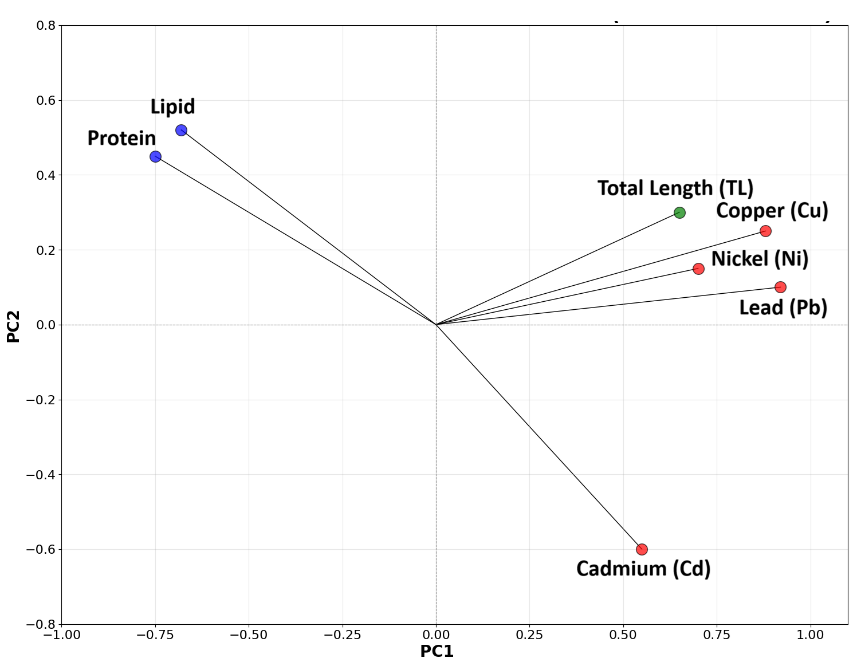
Cadmium (Cd) exhibited a distinctly different trend along the second principal component (PC2) compared to the other elements and nutrient content. This divergence suggests that either the source of cadmium contamination or the mechanism of its accumulation within the tissues of these fish may differ from those of the remaining elements. Cadmium is considered one of the most toxic metals, characterized by its high bioaccumulation potential and
persistence in the aquatic environment [17]. Furthermore, a strong convergence was observed among the vectors for lead (Pb), copper (Cu), and nickel (Ni). This convergence confirms a strong positive correlation among these metals, supporting the hypothesis of a common source within the study area, whether originating from industrial or agricultural activities, wastewater discharge, or fishing boat waste. These findings suggest that aquatic pollution in the study area not only leads to increased concentrations of hazardous elements in the consumed fish tissue but also significantly alters the nutritional composition and dietary quality of this food source. Specifically, the bioaccumulation of heavy metals such as cadmium, lead, and nickel exhibit strong negative correlations with protein and fat content, indicating that contamination directly degrades the macronutrient quality of the muscle tissue. Conversely, the positive correlation between lead and lipid content, alongside the strong association between copper and protein, reveals that different metals exert distinct and sometimes opposing effects on the food matrix. Consequently, the nutritional consistency of L. auratus as a food product is not stable but rather varies predictably with its contaminant burden. From a food science perspective, environmental pollution acts as a hidden variable that alters both the safety and the fundamental compositional integrity of this seafood commodity.
Conclusion
The current study showed that L. auratus from the marine waters of the Latakia Governorate is a nutritionally dense resource in terms of protein and lipids. As for heavy metal content, long-term human consumption remains safe. However, this contamination restricts this safety to moderate intake levels. A clear inverse relationship connects escalating heavy metal levels to overall nutritional value. Lead (Pb) and cadmium (Cd) illustrate this downward trend most prominently. Furthermore, tissue metal accumulation depends heavily on fish size, as illustrated by the positive relationship between total length and both copper (Cu) and lead (Pb). In contrast, other contaminants, such as nickel (Ni) and cadmium (Cd), remain independent of fish size, which may suggest a separate accumulation pathway. Protecting fish quality consequently demands rigorous, ongoing surveillance of local environmental pollution sources.
Acknowledgments
The authors extend their sincere thanks to everyone who contributed to the completion of this research, particularly Dr. Ahmed Mahphood and Jaafar Barakat, for their assistance with technical matters.
Conflict of interest statement
The authors declared no conflict of interest.
Funding statement
The authors declared that no funding was received in relation to this manuscript.
Data availability statement
The authors stated that all experimental data will be made available upon reasonable request to the corresponding author.
References
- Celina O, Aroloye ON. Heavy metal concentration and public health risk in consuming Sardinella maderensis (Sardine), Sarotherodon melanotheron (Tilapia), and Liza falicipinis (Mullet) harvested from Bonny River, Nigeria. J. Oceanogr. Mar. Sci. 2020;11(1):1-10. DOI
- Yi Y, Tang C, Yi T, Yang Z, Zhang S. Health risk assessment of heavy metals in fish and accumulation patterns in food web in the upper Yangtze River, China. Ecotoxicol. Environ. Saf. 2017;145:295-302. DOI
- Barakat I, Saad A, Nisafi I. Influence of seasonal variation on the biochemical composition of both sexes of the round sardinella Sardinella aurita (Valenciennes, 1847) caught in the marine water of Lattakia Governorate (Syria). J. Mater. Environ. Sci. 2022;13(7):747-75.
- Rudyk-Leuska N, Leuskyi M, Yevtushenko N, Khyzhniak M, Buzevich I, Makarenko A, Kotovska G, Kononenko I. Characteristics of protein, lipid, and carbohydrate metabolism of fish of the Kremenchuk Reservoir in the prespawning period. Potravinarstvo Slovak J. Food Sci. 2022;16:490-501. DOI
- FAO/WHO. Codex Committee on Food Additives and Contaminants. World Health Organization: The Hague, The Netherlands. 2017.
- He S, Li P, Liu L, Li Z. Correction to: NMR technique revealed the metabolic interference mechanism of the combined exposure to cadmium and tributyltin in grass carp larvae. Environ. Sci. Pollut. Res. 2022;30(7):17839-9. DOI
- Elshinnawy IA, Almaliki AH. Al Bardawil Lagoon Hydrological Characteristics. Sustainability. 2021;13(13):7392. DOI
- Tchounwou PB, Yedjou CG, Patlolla AK, Sutton DJ. Heavy Metal Toxicity and the Environment. In: Experientia Supplementum. Springer Basel. 2012. DOI
- Shahjahan M, Taslima K, Rahman MS, Al-Emran M, Alam SI, Faggio C. Effects of heavy metals on fish physiology – A review. Chemosphere. 2022;300:134519. DOI
- Banday UZ, Swaleh SB, Usmani N. Insights into the heavy metal-induced immunotoxic and genotoxic alterations as health indicators of Clarias gariepinus inhabiting a rivulet. Ecotoxicol. Environ. Saf. 2019;183:109584. DOI
- Wang Y, Noman A, Zhang C, AL-Bukhaiti WQ, Abed SM. Effect of fish-heavy metals contamination on the generation of reactive oxygen species and its implications on human health: a review. Front. Mar. Sci. 2024;11:1500870. DOI
- Kumar M, Singh S, Jain A, Yadav S, Dubey A, Trivedi SP. A review on heavy metal-induced toxicity in fishes: Bioaccumulation, antioxidant defense system, histopathological manifestations, and transcriptional profiling of genes. J. Trace Elem. Med. Biol. 2024;83:127377. DOI
- Jamil Emon F, Rohani MF, Sumaiya N, Tuj Jannat MF, Akter Y, Shahjahan M, Abdul Kari Z, Tahiluddin AB, Goh KW. Bioaccumulation and Bioremediation of Heavy Metals in Fishes—A Review. Toxics. 2023;11(6):510. DOI
- Gopal V, Parvathy S, Balasubramanian PR. Effect of Heavy Metals on the Blood Protein Biochemistry of the Fish Cyprinus carpio andi Use as a Bio-Indicator of Pollution Stress. Environ. Monit. Assess. 1997;48(2):117-24. DOI
- Palanisamy PG, Sasikala D, Mallikaraj NB, Natarajan GM. Electroplating industrial effluent chromium induced changes in carbohydrates metabolism in air breathing cat fish Mystus cavasius (Ham). Asian J. Exp. Biol. Sci. 2011;2:521-4.
- Yacoub AM, Gad NS. Accumulation of some heavy metals and biochemical alterations in muscles of Oreochromis niloticus from the River Nile in Upper Egypt. Int. J. Environ. Sci. Eng. 2012;3:1-10.
- Liu Y, Chen Q, Li Y, Bi L, Jin L, Peng R. Toxic Effects of Cadmium on Fish. Toxics. 2022;10(10):622. DOI
- Zhang Q, Xie Y, Qin R, Huang E, Zhang Z, Zhou J, Liu D, Meng L, Liu Y, Tong T. Effects of cadmium on the growth, muscle composition, digestion, gene expression of antioxidant and lipid metabolism in juvenile tilapia (Oreochromis niloticus). Front. Mar. Sci. 2024;11:1443484. DOI
- Dar SH, Bhat BJ, Pervaiz RZ, Nawaz M. Evaluation of biochemical changes and estimation of protein quantity following the treatment of cadmium in a fresh water cat fish, Clarias batrachus. Int. J. Fish. Aquat. Stud. 2021;9(3):102-9.
- Palermo FF, Risso WE, Simonato JD, Martinez CB. Bioaccumulation of nickel and its biochemical and genotoxic effects on juveniles of the neotropical fish Prochilodus lineatus. Ecotoxicol. Environ. Saf. 2015;116:19-28. DOI
- Sreedevi P, Sivaramakrishna B, Suresh A, Radhakrishnaiah K. Effect of nickel on some aspects of protein metabolism in the gill and kidney of the freshwater fish, Cyprinus carpio L. Environ. Pollut. 1992;77(1):59-63. DOI
- Ali A, Al-Ogaily SM, Al-Asgah NA, Gropp J. Effect of sublethal concentrations of copper on the growth performance of Oreochromis niloticus. J. Appl. Ichthyol. 2003;19(4):183-8. DOI
- Duan Y, Yang Y, Zhang Z, Nan Y, Xiao M. The toxic effect of lead exposure on the physiological homeostasis of grouper: Insight from gut-liver axis. Mar. Pollut. Bull. 2024;207:116926. DOI
- Saad A, Hammoud V. Levels of mercury, cadmium and lead in the tissue of Diplodus vulgaris (Linneus, 1758) (Teleostei Sparidae) from coast of Syria. Rapp. Comm. Int. Mer Méditerranée. 2007;38:308.
- AOAC. Official methods of analysis of AOAC International. 17th ed. Gaithersburg, MD: AOAC International; 2000.
- Soliman Y, Saad A, Hammoud V, Capapé C. Heavy metal concentrations in tissues of red mullet, Mullus barbatus (Mullidae) from the Syrian coast (Eastern Mediterranean Sea). In: Annales: Series Historia Naturalis. Scientific and Research Center of the Republic of Slovenia. 2021;31(2):243-50. DOI
- Kalipci E, Cüce H, Ustaoğlu F, Dereli MA, Türkmen M. Toxicological health risk analysis of hazardous trace elements accumulation in the edible fish species of the Black Sea in Türkiye using multivariate statistical and spatial assessment. Environ. Toxicol. Pharmacol. 2023;97:104028. DOI
- USEPA. Human health risk assessment, risk-based screening table, regional screening level (RSL) summary table. Washington, DC: United States Environmental Protection Agency. 2015.
- Sadeghi P, Loghmani M, Frokhzad S. Human health risk assessment of heavy metals via consumption of commercial marine fish (Thunnus albacares, Euthynnus affinis, and Katsuwonus pelamis) in Oman Sea. Environ. Sci. Pollut. Res. 2020;27(13):14944-52. DOI
- Wang Y, Cao D, Qin J, Zhao S, Lin J, Zhang X, Wang J, Zhu M. Deterministic and probabilistic health risk assessment of toxic metals in the daily diets of residents in industrial regions of Northern Ningxia, China. Biol. Trace Elem. Res. 2023;201(9):4334-48. DOI
- Saad A. Effect of Habitat and Feeding Pattern on the Chemical Composition and Accumulation of Heavy Elements in Some Marine Fish Species in the Syrian Coast. Food Sci. Nutr. 2025;11(1):1-7. DOI
- Zaghloul GY, Eissa HA, Zaghloul AY, Kelany MS, Hamed MA, Moselhy KME. Impact of some heavy metal accumulation in different organs on fish quality from Bardawil Lake and human health risks assessment. Geochem. Trans. 2024;25(1):1. DOI
- Avigliano E, Monferrán MV, Sánchez S, Wunderlin DA, Gastaminza J, Volpedo AV. Distribution and bioaccumulation of 12 trace elements in water, sediment and tissues of the main fishery from different environments of the La Plata basin (South America): Risk assessment for human consumption. Chemosphere. 2019;236:124394. DOI
- Salem ZB, Habib A. Heavy metal concentrations in Liza aurata (Risso, 1810) captured from the Kerkennah Islands (Gulf of Gabes) and associated health risks. J. Coast. Life Med. 2016;4(7):527-30.
- Jelodar HT, Baei MS, Najafpour SH, Fazli H. The comparison of heavy metals concentrations in different organs of Liza aurata inhabiting in southern part of Caspian Sea. World Appl. Sci. J. 2011;14:96.
- Wang W, Rainbow PS. Comparative approaches to understand metal bioaccumulation in aquatic animals. Comp. Biochem. Physiol. Part C Toxicol. Pharmacol. 2008;148(4):315-23. DOI
- Luoma SN, Rainbow PS. Metal contamination in aquatic environments. In: Science and lateral management. Cambridge University Press. 2008.
- Elliott M, Whitfield A. Challenging paradigms in estuarine ecology and management. Estuar. Coast. Shelf Sci. 2011;94(4):306-14. DOI
- Zhou Q, Zhang J, Fu J, Shi J, Jiang G. Biomonitoring: An appealing tool for assessment of metal pollution in the aquatic ecosystem. Anal. Chim. Acta 2008;606(2):135-50. DOI
- Yozukmaz A, Yabanli M, Sel F. Heavy metal bioaccumulation in Enteromorpha intestinalis,(L.) Nees, a macrophytic algae: the example of Kadin Creek (Western Anatolia). Braz. Arch. Biol. Technol. 2018;61:e18160777. DOI
- Esmaeilzade Ashini A, Sadeghi P, Tootooni MM. the effect of monsoon on chemical composition and bioaccumulation of heavy metals in Scomberomorus commerson, lacepede 1800, from Oman Sea. Pollution. 2021;7(4):923-32. DOI
- Ezemonye LI, Adebayo PO, Enuneku AA, Tongo I, Ogbomida E. Potential health risk consequences of heavy metal concentrations in surface water, shrimp (Macrobrachium macrobrachion) and fish (Brycinus longipinnis) from Benin River, Nigeria. Toxicol. Rep. 2019;6:1-9. DOI
- Wang L, Wang H, Gao C, Wang C, Yan Y, Zhou F. Dietary copper for fish: Homeostasis, nutritional functions, toxicity, and affecting factors. Aquaculture. 2024;587:740875. DOI
- Fokina N. Copper and Nickel Induce Changes in the Lipid and Fatty Acid Composition of Anodonta cygnea. J. Xenobiot. 2023;13(1):132-47. DOI
- Samim AR, Singh VK, Vaseem H. Assessment of hazardous impact of nickel oxide nanoparticles on biochemical and histological parameters of gills and liver tissues of Heteropneustes fossilis. J. Trace Elem. Med. Biol. 2022;74:127059. DOI
- Ali Z, Sher N, Muhammad I, Nayab GE, Alouffi A, Almutairi MM, Khan I, Ali A. The combined effect of cadmium and copper induces bioaccumulation, and toxicity and disrupts the antioxidant enzymatic activities of goldfish (Carassius auratus). Toxicol. Rep. 2025;14:101972. DOI
- Begum A, Rabbane MG, Moniruzzaman M, Hasan MR, Chang X. Cadmium Pollution Deteriorates the Muscle Quality of Labeo rohita by Altering Its Nutrients and Intestinal Microbiota Diversity. Biol. Trace Elem. Res. 2025;203(9):4835-52. DOI
- Raeisi S, Alishahi AR, Shaban Pour B, Ojagh SM, Sharifi Rad J, Iriti M. Nutritional composition and antioxidant activity of vobla roach (Rutilus rutilus caspicus) muscle tissue exposed to heavy metals. Bull. Environ. Pharmacol. Life Sci. 2015;4(2):83-90.
- Sahiti H, Bislimi K, Rexhepi A, Kovaci Z, Dalo E. Antioxidant Activity of Vitamin C and E Versus Oxidative Stress Induced by Heavy Metals in Common Carp (Cyprinus carpio). Malays. Appl. Biol. 2023;52(2):33-40. DOI
- Reddy SJ. Impact of heavy metals on changes in metabolic biomarkers of carp fish, Cirrhinus mrigala. Int. J. Bioassays. 2012;1(12):227-32.
- Khan SA, Zhou P, Liu X, Li H, Li J, Rehman ZU, Ahmad I. Response of vitamins A, E, hematological and serum biochemical markers in Crucian carp (Carassius auratus gibelio) exposed to environmental Pb2+ and Cd2+.Acta Biochim. Pol. 2015;62(3):581-7. DOI
- Inal A, Guendouzi Y, Benfares R, Belkacem Y, Kourdali S, Zenati B, Benmoussa S, Boulahdid M. Using the red mullet, European hake, and common seabream as biomonitors of trace metal levels and associated health risks from the southwestern Mediterranean Sea. Mar. Pollut. Bull. 2026;222:118897. DOI
Cite this article:
Barakat I, Saad A, Nisafi I. Heavy metal bioaccumulation and nutritional quality assessment of Liza auratus from the Syrian coast. DYSONA-Applied Science. 2026;7(2):301-312. doi: 10.30493/das.2026.011906