
Community participation in forest conservation: A rural behavioral study in Dara-e-Pech, Kunar Province, Afghanistan
Sayed Abas Agah 1; Zainullabuddin Hakimi 2; Muhammad Asef Shaiq 3*; Ghulam Hazrat Ghulami 1
1, Department of Forestry and Natural Resources, Faculty of Agriculture, Bamyan University, Bamyan, Afghanistan
2, Department of Agricultural Economics and Extension, Faculty of Agriculture, Bamyan University, Bamyan, Afghanistan
3, Department of Agricultural Economics and Extension, Faculty of Agriculture, Baghlan University, Baghlan, Afghanistan
E-mail:
asef.shaiq@gmail.com
Received: 25/06/2026
Acceptance: 20/10/2026
Available Online: 22/10/2027
Published: 01/01/2027

Manuscript link
http://doi.org/10.30493/DAS.2026.012210
Abstract
Forest-dependent rural communities play an important role in the conservation and use of natural resources in Afghanistan. In this study, the relationships among sustainable income and livelihood alternatives, education and awareness, participation in natural resource management, sustainable agricultural technologies, and conservation-related behavioral perceptions among households in Dara-e-Pech District, Kunar Province were examined. A cross-sectional quantitative survey was conducted in four forest-adjacent villages with a total population of 348 households. Questionnaires were distributed to 182 selected households. Four questionnaires were not returned, and 18 returned questionnaires were excluded because of invalid responses. The final analytical sample consisted of 160 households, corresponding to a usable response rate of 87.9%. The questionnaire contained 21 items grouped into five dimensions and used a five-point importance scale. Data were analyzed using descriptive statistics, a one-sample t-test, Spearman’s rank correlation, and partial least squares structural equation modeling (PLS-SEM). The largest correlation between distinct dimensions was between sustainable income and livelihood alternatives and participation in natural resource management, with a coefficient of 0.403, followed by education and awareness and participation, with a coefficient of 0.365. Among the four dimensions examined in relation to conservation-related behavioral perceptions, participation showed the largest positive correlation, with a coefficient of 0.337 (P<0.01). In the simultaneous structural model, participation and education and awareness showed statistically significant positive associations with conservation-related behavioral perceptions, whereas sustainable income and sustainable agricultural technologies did not reach the 5% significance level. The study offers a comprehensive overview of forest-adjacent communities’ perceptions regarding forest conservation. Nevertheless, given the cross-sectional design of the study and the self-reported importance ratings obtained, the findings are interpreted as associations rather than causal relationships or directly observed conservation behavior.
Keywords: Community participation, Forest conservation, Natural resource management, Afghanistan
Introduction
Forests provide essential ecosystem services, including carbon storage, biodiversity conservation, climate regulation, water regulation, and livelihood support for rural and forest-dependent populations [1][2]. Despite their ecological and socioeconomic importance, forests are threatened by loss and degradation due to climate change and anthropogenic activities, which represent a major global environmental concern. Recent global evidence shows that human activities have substantially reduced natural forest carbon stocks and that continued forest loss remains an important challenge for climate and biodiversity conservation [3].
Increasing attention has been given to the role of local communities in forest governance and conservation. Evidence across different forest-management contexts indicates that meaningful participation in decision-making, local rulemaking, and community management institutions can be associated with improved livelihood and conservation outcomes [4-6]. For example, cross-country evidence from forest commons shows that formal community-management organizations and local participation in rulemaking are consistently associated with multiple positive forest-management outcomes [4]. Studies from Kenya and Cameroon similarly emphasize that the quality and form of participation, institutional arrangements, and awareness of local management rules influence the extent to which communities are effectively involved in forest management [5][6].
Community involvement may also contribute to specific conservation activities. Research on forest-fire management, for example, illustrates the potential role of local participation in prevention and mitigation activities [7]. Education and awareness are also relevant dimensions of community-based conservation. Previous research has shown that environmental awareness and related social and psychological factors are associated with conservation attitudes, while education and community participation can support more informed engagement in sustainable forest management [8][9]. However, positive attitudes or awareness should not automatically be interpreted as evidence of actual conservation behavior, since the relationship between perceptions, intentions, and behavior may depend on institutional and socioeconomic conditions.
These issues are particularly relevant in Afghanistan, where forest management takes place in a fragile institutional and socioeconomic context. Research on community-based forest management in Afghanistan highlights challenges related to governance capacity, insecurity, resource dependence, institutional continuity, and the role of local organizations such as community forest associations and traditional institutions [10][11]. At the same time, recent household-level evidence from Afghanistan suggests that community forestry institutions may support rural livelihoods when participation is accompanied by practical services such as market access and training [12]. These findings indicate that community participation should be understood in relation to broader livelihood, institutional, and capacity-building conditions rather than as an isolated determinant of conservation outcomes.
Dara-e-Pech District in Kunar Province is well known for its extensive forest resources and forest-dependent rural communities [13]. However, empirical evidence remains limited regarding how livelihood conditions, education and awareness, participation in natural resource management, and access to sustainable agricultural technologies are related to conservation-oriented perceptions among households in this area. Understanding these relationships is critical since forest conservation in fragile rural settings may depend on the interaction of socioeconomic, institutional, and perceptual factors rather than on a single dimension.
Accordingly, this study examines whether sustainable income and livelihood alternatives, education and awareness, participation in natural resource management, and sustainable agricultural technologies are associated with conservation-related behavioral perceptions among households in forest-adjacent villages of Dara-e-Pech District. Given the cross-sectional nature of the study, the analysis focuses on statistical associations rather than causal effects.
Material and Methods
Study area
Dara-e-Pech District is located in Kunar Province in northeastern Afghanistan. According to provincial administrative and statistical information, the district has an estimated population of approximately 63,950 and covers an area of approximately 549.28 km² [13]. The district is constituted of 115 villages, including Darko, Wardish, Kolak, and Tangi, which were the villages considered in the present study.
The terrain varies considerably in elevation, with some areas reaching approximately 1,000 m above sea level. Seasonal temperatures range from approximately 38°C during summer to below freezing in higher-elevation areas during winter. Reported annual precipitation ranges from approximately 400 to 1,200 mm, with snowfall occurring in higher elevations during winter [13].
Research design
This study employed a cross-sectional quantitative survey design with a descriptive correlational approach. The purpose was to examine the associations between livelihood-related, educational, participatory, and technological dimensions and conservation-related behavioral perceptions among households in forest-adjacent villages of Dara-e-Pech District, Kunar Province, Afghanistan. Cross-sectional studies measure variables at a particular point or period in time and can identify associations between variables, but they do not establish temporal sequence or causal relationships [14]. Therefore, all relationships identified in the present study were interpreted as associations rather than causal effects.
Target population and sampling procedure
The target population consisted of households residing in four forest-adjacent villages of Dara-e-Pech District: Tangi, Kolak, Darko, and Wardish. These villages were selected due to their proximity to forest resources and the substantial dependence of local communities on those resources. The total target population comprised 348 households, distributed as shown in Table 1.
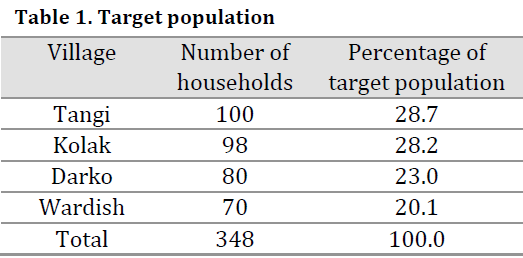
Household lists obtained from the respective village councils were used as the sampling frames. The reported household counts were also consistent with information available from the relevant Statistics and Information authorities. Selection was conducted at the household level. Within the available household lists, households were selected using a lottery-based random procedure. Selected households that could not be reached during fieldwork were treated as nonresponses and were not replaced.
The required sample size was estimated using the finite-population approach proposed by Krejcie and Morgan [15]:
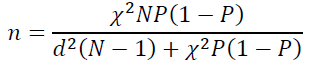
where:
n: The required sample size (the number of responses or participants needed for the study).
χ² (Chi-square): The Chi-square value for the desired confidence level χ²=3.841, which corresponds to a 95% confidence level.
N: The total population size (N=348).
P: The estimated proportion of the population that has the characteristic of interest (P=0.50).
d: The degree of accuracy (d=0.05, which represents a ±5% margin of error).
The Krejcie–Morgan calculation therefore indicated a sample of approximately 182 households. In the field implementation of the study, 182 households were selected and 182 questionnaires were distributed. A total of four questionnaires were not returned because the selected households were unavailable during fieldwork. Of the 178 questionnaires returned, 18 were excluded because the responses were invalid and could not be used in the statistical analysis. Consequently, 160 valid questionnaires (87.9% of the original sample size) were retained for analysis.
Questionnaire development
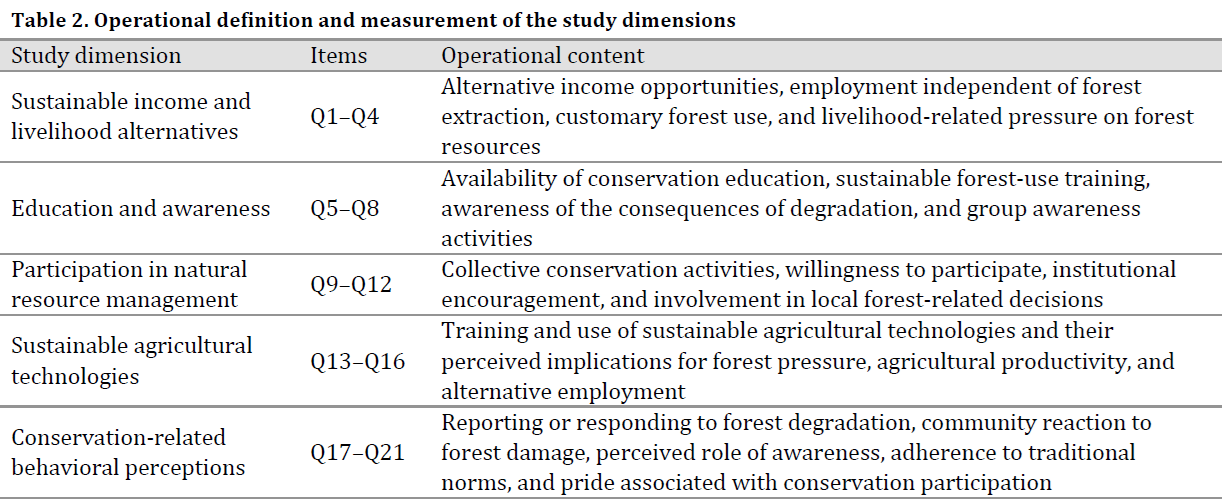
Data were collected using a researcher-developed questionnaire. The instrument was developed on the basis of the objectives of the study, relevant previous research, and expert judgment concerning the content domains to be represented in the questionnaire. Expert review is commonly used during instrument development to assess whether proposed items adequately represent the intended content domain [16]. The questionnaire consisted of two main sections. The first section collected demographic and occupational information about respondents. The second section consisted of 21 items organized into five study dimensions: Sustainable income and livelihood alternatives (4 items), Education and awareness (4 items), Participation in natural resource management (4 items), Sustainable agricultural technologies (4 items), and Conservation-related behavioral perceptions (5 items). This structure is consistent with the questionnaire and the underlying thesis documentation (Supplementary Table 1).
All questionnaire items were rated using a five-point importance scale (1=very low importance, 2=low importance, 3=moderate importance, 4=high importance, 5=very high importance). The original questionnaire explicitly used these importance anchors. Likert-type response formats are widely used for ordered responses in survey research, although the interpretation of individual Likert-type items should reflect their ordinal nature [17]. Importantly, the questionnaire did not ask respondents how frequently they performed each conservation behavior. Instead, respondents rated the importance of statements describing livelihood, participation, education, technology, and conservation-related issues. For this reason, the dependent dimension is referred to throughout the work as “conservation-related behavioral perceptions” rather than “Conservation Ecological Behaviors”, since this terminology more accurately reflects what the instrument measured.
Operationalization of study variables
The five study dimensions were operationalized through the corresponding questionnaire items, as summarized in Table 2.
For each respondent i, the composite score for study dimension k was calculated as the arithmetic mean of the items belonging to that dimension:
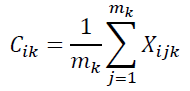
where Cik denotes the composite score of respondents for dimension k, Xijk is the response to item j, and mk is the number of items included in that dimension.
Thus, for example, the participation score was calculated as:

and the conservation-related behavioral perception score was:

The five items used for the conservation-related outcome represent heterogeneous conservation-related perceptions and responses rather than direct observations of actual behavior. For example, Q17 refers to reporting or intervening when forest degradation is observed, Q18 concerns community reactions to forest damage, Q19 concerns awareness and behavior, Q20 addresses adherence to traditional customs, and Q21 measures pride associated with participation.
Data collection procedure
Questionnaires were administered through field-based data collection in the selected villages. The questionnaire was originally prepared in Persian, whereas Pashto was the primary language spoken by the study population. Therefore, a Pashto-speaking assistant accompanied the researcher during data collection and orally translated questionnaire items for respondents when required. Cross-cultural adaptation guidelines emphasize that language adaptation can affect the equivalence of self-report instruments and should therefore be explicitly documented [18]. In the present study, a formally validated Pashto version was not available; consequently, the use of oral translation is acknowledged as a potential source of translation and interviewer-related variability. Selected households that were unavailable during the field survey (4 households) were not replaced.
Statistical analysis
The 160 valid questionnaires were coded and analyzed using SPSS version 22. Analyses were conducted on the composite scores. Descriptive statistics included the mean, standard deviation, minimum, maximum, skewness, and kurtosis for each study dimension. The descriptive analysis was intended to summarize respondents’ scores and was not used to classify values as “favorable” or “unfavorable.” Because the questionnaire consisted of ordered Likert-type responses and the primary objective was to assess the direction and strength of monotonic associations among the study dimensions, Spearman’s rank correlation coefficient was used for the bivariate analysis. Spearman correlation measures the association between ranked variables and does not require a linear relationship or normally distributed raw variables [19]. Conceptually, Spearman’s coefficient may be expressed as the Pearson correlation between the rank-transformed variables:
rs = Corr[R,(X)R(Y)]
where R(X) and R(Y) represent the ranks of variables X and Y, respectively.
In addition to descriptive statistics, a one-sample t-test was used as a supplementary analysis to compare the mean score of each study dimension with the theoretical midpoint of the five-point importance scale (µ0=3). The value of 3 corresponds to “moderate importance.” The test was conducted using the final analytical sample of 160 respondents, with statistical significance evaluated at the 0.05 level. Spearman’s rank correlation coefficient was used to examine bivariate monotonic associations among the five study dimensions. Spearman’s correlation was selected because the questionnaire responses were based on an ordinal Likert-type scale and the method does not require normally distributed raw variables.
Partial least squares structural equation modeling (PLS-SEM) was also used to examine the simultaneous structural associations between sustainable income and livelihood alternatives, education and awareness, participation in natural resource management, sustainable agricultural technologies, and conservation-related behavioral perceptions. The PLS-SEM model was re-estimated using the final analytical sample of 160 respondents. Statistical significance of the path coefficients was assessed using 5,000 bootstrap resamples. The structural model was evaluated using standardized path coefficients (β), bootstrap standard errors, t-statistics, p-values, 95% confidence intervals, R2, f2, and variance inflation factors (VIFs). Measurement-model reliability and convergent validity were assessed using Cronbach’s alpha, rho_A, composite reliability (CR), and average variance extracted (AVE).
Results
Descriptive statistics of study dimensions
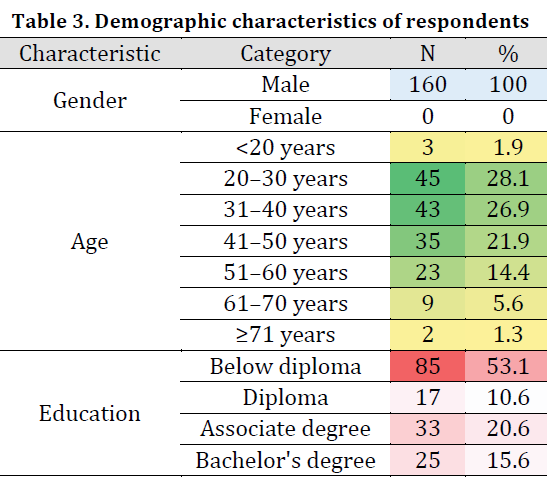
The demographic characteristics of the final analytical sample are summarized in Table 3. All 160 respondents were males. In terms of age, the largest group consisted of respondents aged 20–30 years (28.1%), followed by those aged 31–40 years (26.9%) and 41–50 years (21.9%). Respondents aged 51–60 years accounted for 14.4% of the sample, while relatively small proportions were aged 61–70 years (5.6%), below 20 years (1.9%), or 71 years and older (1.3%). Overall, the sample was concentrated primarily among respondents between 20 and 50 years of age (76.9% of respondents). Educational attainment also varied across respondents. The largest proportion had education below the diploma level (53.1%), while smaller proportions had completed a diploma, an associate-level qualification, or a bachelor’s degree (46.9% collectively). These characteristics provide descriptive context for interpreting the perceptions and associations reported in the subsequent analyses.
Descriptive statistics for the five study dimensions based on the final analytical sample of 160 households are presented in Table 4. All five mean scores were below the midpoint value of 3. Sustainable agricultural technologies had the highest mean score (M=2.688), followed closely by sustainable income and livelihood alternatives (M=2.683). Participation in natural resource management had the lowest mean score (M=2.364). These scores are reported descriptively and are not classified as “favorable” or “unfavorable.”

One-Sample t-Test
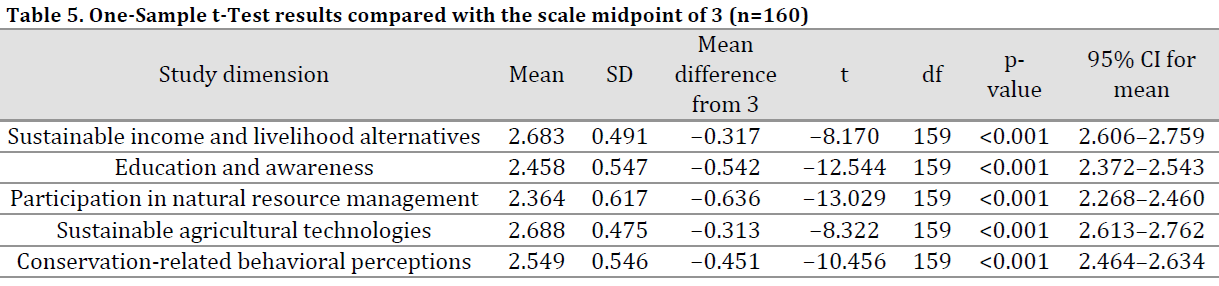
A one-sample t-test was conducted as a supplementary analysis to compare the mean score of each study dimension with the theoretical midpoint of the five-point importance scale. The response scale ranged from 1 (very low importance) to 5 (very high importance), with a value of 3 representing “moderate importance”. Because each study dimension was represented by a composite score calculated from multiple questionnaire items, the midpoint of 3 was used as a descriptive reference value.
The null and alternative hypotheses were specified as:
H0 : µ=3
H1 : µ≠3
where µ represents the population mean of the corresponding study dimension. The test statistic was calculated as:
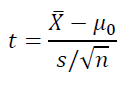
where X̄ is the sample mean, µ0=3 is the theoretical midpoint, “s” is the sample standard deviation, and n=160 is the number of valid observations. As shown in Table 5, the mean scores of all five study dimensions were statistically significantly below the midpoint of 3 (p<0.001). Participation in natural resource management had the lowest mean score (M=2.364), whereas sustainable agricultural technologies had the highest mean score (M=2.688). These findings indicate that, on average, respondents rated the importance of the examined dimensions below the moderate midpoint of the scale. The results should not, however, be interpreted as a classification for the dimensions as “favorable” or “unfavorable.”
Spearman correlation analysis
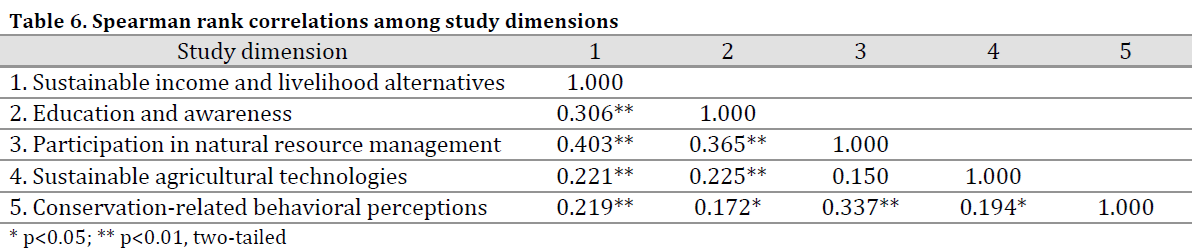
The largest correlation (Table 6) between distinct dimensions was observed between (1) sustainable income and livelihood alternatives and (3) participation in natural resource management (0.403, p<0.01). The second-largest correlation was between (2) education and awareness and (3) participation in natural resource management (0.365, p<0.01).
When considering only correlations with (5) conservation-related behavioral perceptions, participation in natural resource management (3) showed the largest coefficient (0.337, p<0.01), followed by (1) sustainable income and livelihood alternatives (0.219, p<0.01), and (4) sustainable agricultural technologies (0.194, p<0.05). On the other hand, the correlation between (3) participation in natural resource management and (4) sustainable agricultural technologies was non-significant (0.150, p>0.05).
PLS-SEM Structural Model Results
Partial least squares structural equation modeling (PLS-SEM) was used to examine the simultaneous associations of sustainable income and livelihood alternatives, education and awareness, participation in natural resource management, and sustainable agricultural technologies with conservation-related behavioral perceptions. The structural model was re-estimated using the final analytical sample of 160 respondents. Statistical significance of the path coefficients was assessed using 5,000 bootstrap resamples. PLS-SEM results were reported using standardized path coefficients (β), bootstrap standard errors, t-statistics, p-values, 95% confidence intervals, and f2 effect sizes (Table 7), following recommended PLS-SEM reporting practices [20]. Because the study was cross-sectional, the estimated path coefficients were interpreted as standardized associations rather than causal effects. The structural model explained 31.5% of the variance in conservation-related behavioral perceptions (R2=0.315).
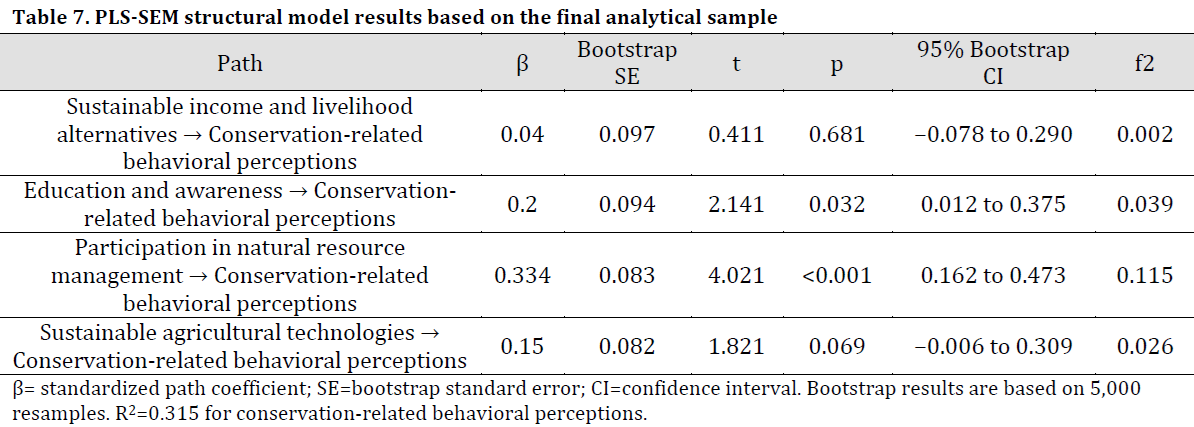
Participation in natural resource management showed the largest positive standardized association with conservation-related behavioral perceptions (β=0.334, p<0.001). The 95% bootstrap confidence interval did not include zero (0.162 to 0.473), providing evidence of a statistically significant positive association. However, the corresponding effect size was relatively small (f2=0.115), indicating that statistical significance should not be interpreted as evidence of a large practical effect.
Education and awareness also showed a positive and statistically significant association with conservation-related behavioral perceptions (β=0.200, p=0.032; 95% CI: 0.012 to 0.375). Similarly, the corresponding incremental effect size for this association was modest (f2=0.039). The path from sustainable agricultural technologies to conservation-related behavioral perceptions was positive (β=0.150) but did not reach the conventional 5% level of statistical significance (p=0.069). Its 95% bootstrap confidence interval included zero (−0.006 to 0.309), and its effect size was small (f2=0.026). The structural-model results therefore did not provide sufficient evidence of an association between sustainable agricultural technologies and conservation-related behavioral perceptions at the 5% significance level after accounting for other predictors. Sustainable income and livelihood alternatives showed little unique association with conservation-related behavioral perceptions after other predictors were included simultaneously in the model (β=0.040, p=0.681; 95% CI: −0.078 to 0.290). The corresponding effect size was negligible (f2=0.002). The inner-model variance inflation factors (VIFs) were 1.410 for sustainable income and livelihood alternatives, 1.497 for education and awareness, 1.424 for participation in natural resource management, and 1.249 for sustainable agricultural technologies. These low values did not indicate a substantial collinearity problem among the predictors.
The Spearman correlations (Table 6) and the PLS-SEM path coefficients (Table 7) describe different statistical relationships. Spearman correlation measures the unadjusted bivariate association between two composite scores. In contrast, the PLS-SEM path coefficients describe the standardized associations with conservation-related behavioral perceptions when other predictors are included simultaneously in the structural model. For example, the Spearman correlation between participation and conservation-related behavioral perceptions was 0.337, whereas the corresponding standardized path coefficient was 0.334. The correlations of 0.403 between livelihood-related scores and participation and 0.365 between educational scores and participation concern different pairs of dimensions and should not be substituted for the path coefficient linking participation to conservation-related behavioral perceptions. Neither analysis establishes causal relationships.
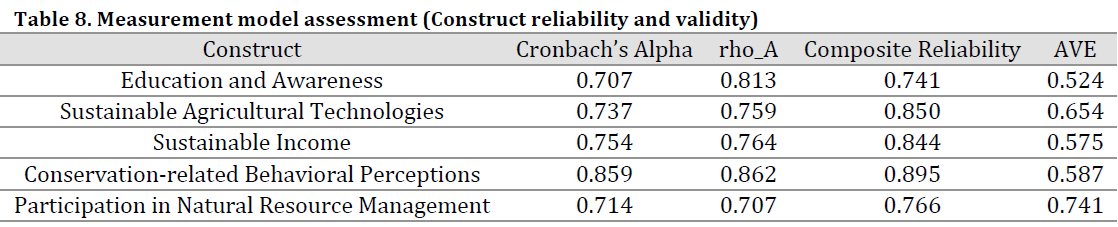
The reliability and convergent validity of the measurement model were assessed using Cronbach’s alpha, rho_A, composite reliability (CR), and average variance extracted (AVE) (Table 8). Cronbach’s alpha values ranged from 0.707 to 0.859, while composite reliability values ranged from 0.741 to 0.895. The AVE values ranged from 0.524 to 0.741. These results indicate acceptable internal consistency reliability and convergent validity of the constructs.
Discussion
The findings for sustainable income and livelihood alternatives differed between the bivariate correlation analysis and the simultaneous structural model. The largest correlation between distinct dimensions was between sustainable income and livelihood alternatives and participation in natural resource management, with a coefficient of 0.403. The second-largest correlation was between education and awareness and participation, with a coefficient of 0.365. Both were statistically significant at the 1% level. These results indicate that respondents with higher composite scores for livelihood-related and educational dimensions also tended to have higher participation scores. However, the cross-sectional data do not establish whether livelihood conditions or education increase participation, nor do these correlations demonstrate a mediating role for participation.
When the comparison was restricted to correlations with conservation-related behavioral perceptions, participation in natural resource management had the largest observed coefficient, at 0.337, with a p-value below 0.01. Participation also showed a positive association with the outcome in the simultaneous PLS-SEM model, with a standardized path coefficient of 0.334 (p<0.01). Its incremental effect size was 0.115, indicating a relatively small contribution. Thus, participation had the largest observed association with the conservation-related outcome among the four dimensions examined, but it should not be described as a dominant causal factor. This finding is broadly consistent with research linking meaningful local participation, community institutions, and involvement in forest-management decisions to community engagement and forest-management outcomes [4-6].
Education and awareness also showed a positive correlation with conservation-related behavioral perceptions, with a coefficient of 0.172 and a p-value of 0.030. In the simultaneous structural model, its standardized path coefficient was 0.200, with a p-value of 0.032. The incremental effect size of 0.039 indicates a small contribution. These results suggest that the educational dimension was associated with conservation-related perceptions, although the magnitude of this association should not be overstated. Previous research similarly emphasizes the relevance of conservation knowledge and awareness of local management rules, while recognizing the importance of the institutional context [6].
The findings for sustainable income and livelihood alternatives require a more cautious interpretation than in the original manuscript. Sustainable income showed a positive bivariate correlation with conservation-related behavioral perceptions (rs=0.219, p=0.005); however, its standardized path coefficient became very small and statistically non-significant when the other explanatory variables were considered simultaneously (β=0.040, p=0.681; f2=0.002). This suggests that the observed bivariate relationship may partly overlap with participation, education, or other dimensions included in the model rather than representing a strong independent association. The broader literature also indicates that livelihood–forest relationships are context-dependent. Studies from Nepal and Uganda show that changes in livelihood strategies and diversification can alter forest dependence and willingness to participate in community forest management in different ways [21][22]. In Afghanistan, forest-dependent livelihoods, harvesting pressures, conflict, and local management arrangements are similarly interconnected, making simple interpretations of income as an independent driver of conservation problematic [10].
Sustainable agricultural technologies also showed a positive bivariate relationship with conservation-related behavioral perceptions (rs=0.194, p=0.014). However, after simultaneous consideration of the other predictors, the structural association did not reach the conventional 5% significance level (β=0.150, p=0.069), and its estimated effect size was small (f2=0.026). Accordingly, the present data do not provide sufficient evidence to conclude that the use of sustainable agricultural technologies independently improves conservation-related perceptions. Rather, the positive bivariate association suggests that technology may be linked to conservation perceptions through broader livelihood, education, or participation processes. Further research is needed to identify these possible pathways.
The structural model explained approximately 31.5% of the variance in conservation-related behavioral perceptions (R2=0.315). This indicates that the dimensions examined in the study are relevant but leave a substantial share of variation unexplained. Factors not directly measured in the present survey, such as local authority structures, trust in institutions, patronage relationships, enforcement arrangements, conflict exposure, land and resource rights, or household dependence on particular forest products, may also contribute to differences in conservation-related perceptions.
The descriptive results provide additional context. The mean scores for all five dimensions were below the midpoint value of 3 on the five-point importance scale. Participation in natural resource management had the lowest mean score (M=2.364), despite showing the strongest association with the conservation-related outcome. This combination suggests that participation may be particularly relevant to conservation perceptions while still being relatively weakly expressed or valued among respondents in the surveyed communities. This distinction is important for interpretation and avoids treating statistical association as evidence that high levels of participation already exist in the study area.
Finally, the questionnaire measured respondents perceived importance of conservation-related statements rather than the frequency of objectively observed behaviors. Therefore, the dependent dimension should be interpreted as conservation-related behavioral perceptions rather than direct conservation behavior. Claims concerning actual reductions in forest degradation, changes in harvesting behavior, social cohesion, ownership, or long-term conservation outcomes cannot be established from the present data alone.
Several limitations should be considered when interpreting the findings of this study. First, the cross-sectional design identifies statistical associations but cannot establish temporal ordering or causal relationships. Consequently, the reported correlations and PLS-SEM path coefficients should not be interpreted as causal effects. Second, the study relied on self-reported questionnaire responses. Such responses may be affected by recall error, social-desirability bias, or respondents’ perceptions of what constitutes an acceptable answer. In addition, the five-point scale measured the perceived importance of questionnaire statements rather than the frequency of directly observed conservation behaviors. The findings therefore describe conservation-related perceptions and orientations rather than objectively verified behavior. Third, the study was conducted in only four forest-adjacent villages in Dara-e-Pech District. These villages were selected due to their proximity to forests and their dependence on forest resources. Consequently, the findings are context-specific and should not be generalized automatically to other districts or rural communities in Afghanistan. Fourth, the questionnaire was originally prepared in Persian, whereas Pashto was the primary language spoken by respondents. A Pashto-speaking assistant orally translated the questions during fieldwork. Although this approach facilitated communication, the absence of a formally translated and independently validated Pashto version may have introduced translation or interviewer-related variability. Fifth, field access and the security context may have influenced both household availability and respondents’ willingness to discuss issues related to forest management openly. More broadly, insecurity and conflict may influence relationships between communities, government institutions, and natural-resource management in ways that could not be measured directly in the present survey. Evidence from forest-dependent communities in Afghanistan also indicates that persistent instability and armed conflict can constrain forest-management options and access to technical support [10]. Finally, local power structures, traditional authority, patronage networks, informal enforcement systems, and conflict dynamics were not directly measured. These factors may influence both opportunities for participation and the responses provided by households. Future research should explicitly measure these institutional and political-economy dimensions and should, where possible, use longitudinal, multi-site, or mixed-method designs.
Conclusion
In this study, the relationships between sustainable income and livelihood alternatives, education and awareness, participation in natural resource management, sustainable agricultural technologies, and conservation-related behavioral perceptions were examined among households in four forest-adjacent villages of Dara-e-Pech District, Kunar Province. The strongest positive association with conservation-related behavioral perceptions was displayed by participation in natural resource management. This link remained statistically significant during the simultaneous evaluation of all explanatory variables. A positive and statistically significant independent association was also demonstrated by education and awareness, though its magnitude was comparatively small. Conversely, sustainable income and livelihood alternatives alongside sustainable agricultural technologies correlated positively with the conservation outcome at the bivariate level. However, statistically significant independent associations failed to materialize for these factors within the simultaneous structural model. Future forest-management research and locally adapted interventions may need to prioritize community participation and conservation-focused education based on these patterns. Yet, the results do not prove that expanding participation or education will directly cause improvements in actual forest-conservation behavior. Specific livelihood programs, technologies, institutional reforms, or financial interventions cannot be recommended solely from the presented findings without further empirical testing. Context-specific associations rather than causal effects or directly observed conservation outcomes must be inferred because the design was cross-sectional, self-reported, geographically restricted, and reliant on an importance-oriented questionnaire. Broader community sampling needs to be incorporated into subsequent investigations. Future research should also capture direct measurements of conservation behavior and forest outcomes while explicitly examining institutional arrangements, local power relations, conflict dynamics, and livelihood dependence.
Supplementary Files
Conflict of interest statement
The authors declared no conflict of interest.
Funding statement
The authors declared that no funding was received in relation to this manuscript.
Data availability statement
The used questionnaire is provided as supplementary material. The authors stated that data used in this study will be made available upon reasonable request from the corresponding author.
References
- Hallaj Z, Bijani M, Karamidehkordi E, Yousefpour R, Yousefzadeh H. Forest land use change effects on biodiversity ecosystem services and human well-being: A systematic analysis. Environ. Sustain. Indic. 2024;23:100445. DOI
- Raman R, Manalil S, Dénes DL, Nedungadi P. The role of forestry sciences in combating climate change and advancing sustainable development goals. Front. For. Glob. Change. 2024;7:1409667. DOI
- Mo L, Zohner CM, Reich PB, Liang J, De Miguel S, Nabuurs GJ, Renner SS, Van Den Hoogen J, Araza A, Herold M, Mirzagholi L. Integrated global assessment of the natural forest carbon potential. Nature. 2023;624(7990):92-101. DOI
- Fischer HW, Chhatre A, Duddu A, Pradhan N, Agrawal A. Community forest governance and synergies among carbon, biodiversity and livelihoods. Nat. Clim. Change. 2023;13(12):1340-7. DOI
- Ombogoh DB, Mwangi E, Larson AM. Community participation in forest and water management planning in Kenya: challenges and opportunities. For. Trees Livelihoods. 2022;31(2):104-22. DOI
- Kimengsi JN, Deodatus Ngu N. Community participation and forest management dynamics in rural Cameroon. World Dev. Perspect. 2022;27:100442. DOI
- Riza S, Fata YA, Arifin S, Hadiwijoyo E, Hidayatullah RR, Ishaq RM, Lestari ND, Putra AN, Lestariningsih ID, Suprayogo D. Community Participation in Forest Conservation as A Forest Fire Mitigation and Adaptation on The Arjuno Mountain. Habitat. 2023;34(3):321-35. DOI
- Coronel-Chugden J, Guayanay ROL, Huaman-Romani Y, Bellido-Ascarza Y, Ramirez AL. Sustainable forest management from education and community participation. Int. J. Innov. Res. Sci. Stud. 2025;8(1):2385-94. DOI
- Yaghoubi Farani A, Mohammadi Y, Ghahremani F, Ataei P. How can Iranian farmers’ attitudes toward environmental conservation be influenced?. Global Ecol. Conserv. 2021;31:e01870. DOI
- Khurram S, Larawai MI, Shalizi MN, Akamani K, Groninger JW. Assessing regeneration strategies for sustaining intensively used Chilgoza pine-dominated community forests in Afghanistan. Trees For. People. 2023;14:100443. DOI
- Khurram S, Shalizi MN, Bashari M, Akamani K, Groninger JW. Barriers and opportunities regarding community-based forest management in Afghanistan: considerations for fragile states. Environ. Conserv. 2023;51(1):6-16. DOI
- Sahebzada MM, Ahmadzai MR, Salleh SA. Market Access and Livelihood Outcomes in Community Forestry: Evidence from Chilgoza Pine Forests in Paktia, Afghanistan. Forests. 2026;17(9):1015. DOI
- Kunar Province Directorate of Economy. Provincial development plan (PDP): socio-economic and development program of Kunar Province. Kunar: Provincial Development Committee. 2025.
- Setia M. Methodology series module 3: Cross-sectional studies. Indian J. Dermatol. 2016;61(3):261. DOI
- Krejcie RV, Morgan DW. Determining Sample Size for Research Activities. Educ. Psychol. Meas. 1970;30(3):607-10. DOI
- Boateng GO, Neilands TB, Frongillo EA, Melgar-Quiñonez HR, Young SL. Best Practices for Developing and Validating Scales for Health, Social, and Behavioral Research: A Primer. Front. Public Health. 2018;6:149. DOI
- Sullivan GM, Artino AR. Analyzing and Interpreting Data From Likert-Type Scales. J. Grad. Med. Educ. 2013;5(4):541-2. DOI
- Beaton DE, Bombardier C, Guillemin F, Ferraz MB. Guidelines for the Process of Cross-Cultural Adaptation of Self-Report Measures. Spine. 2000;25(24):3186-91. DOI
- Schober P, Boer C, Schwarte LA. Correlation Coefficients: Appropriate Use and Interpretation. Anesth. Analg. 2018;126(5):1763-8. DOI
- Hair JF, Risher JJ, Sarstedt M, Ringle CM. When to use and how to report the results of PLS-SEM. Eur. Bus. Rev. 2019;31(1):2-24. DOI
- Shahi N, Bhusal P, Paudel G, Kimengsi JN. Forest—People nexus in changing livelihood contexts: Evidence from community forests in Nepal. Trees For. People. 2022;8:100223. DOI
- Mawa C, Tumusiime DM, Babweteera F, Okwir E, Tabuti JRS. Community-based forest management promotes survival-led livelihood diversification among forest-fringe communities in Uganda. Front. For. Glob. Change. 2023;6:1125247. DOI
Cite this article:
Agah SA, Hakimi Z, Shaiq MA, Ghulami GH. Community participation in forest conservation: A rural behavioral study in Dara-e-Pech, Kunar Province, Afghanistan. DYSONA-Applied Science. 2027;8(1):102-113. doi: 10.30493/das.2026.012210